 English
 中文
中文







How High Performance Ceramic Parts Solve Demanding Engineering Problems
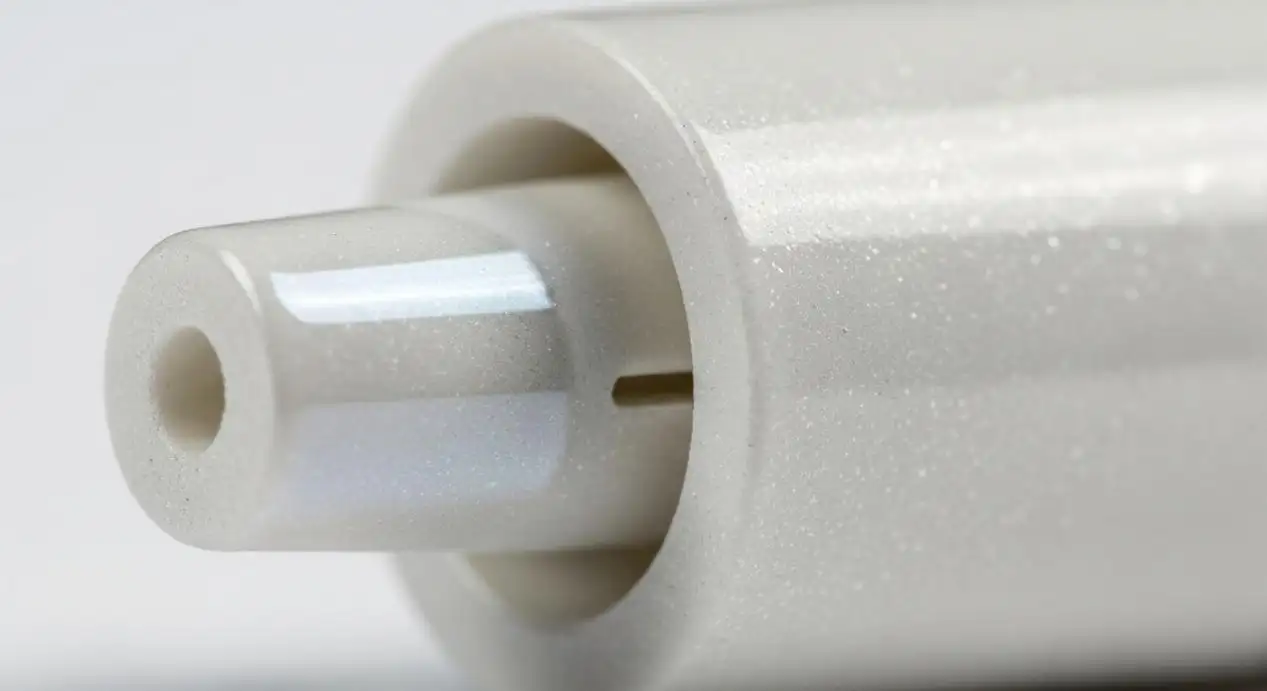

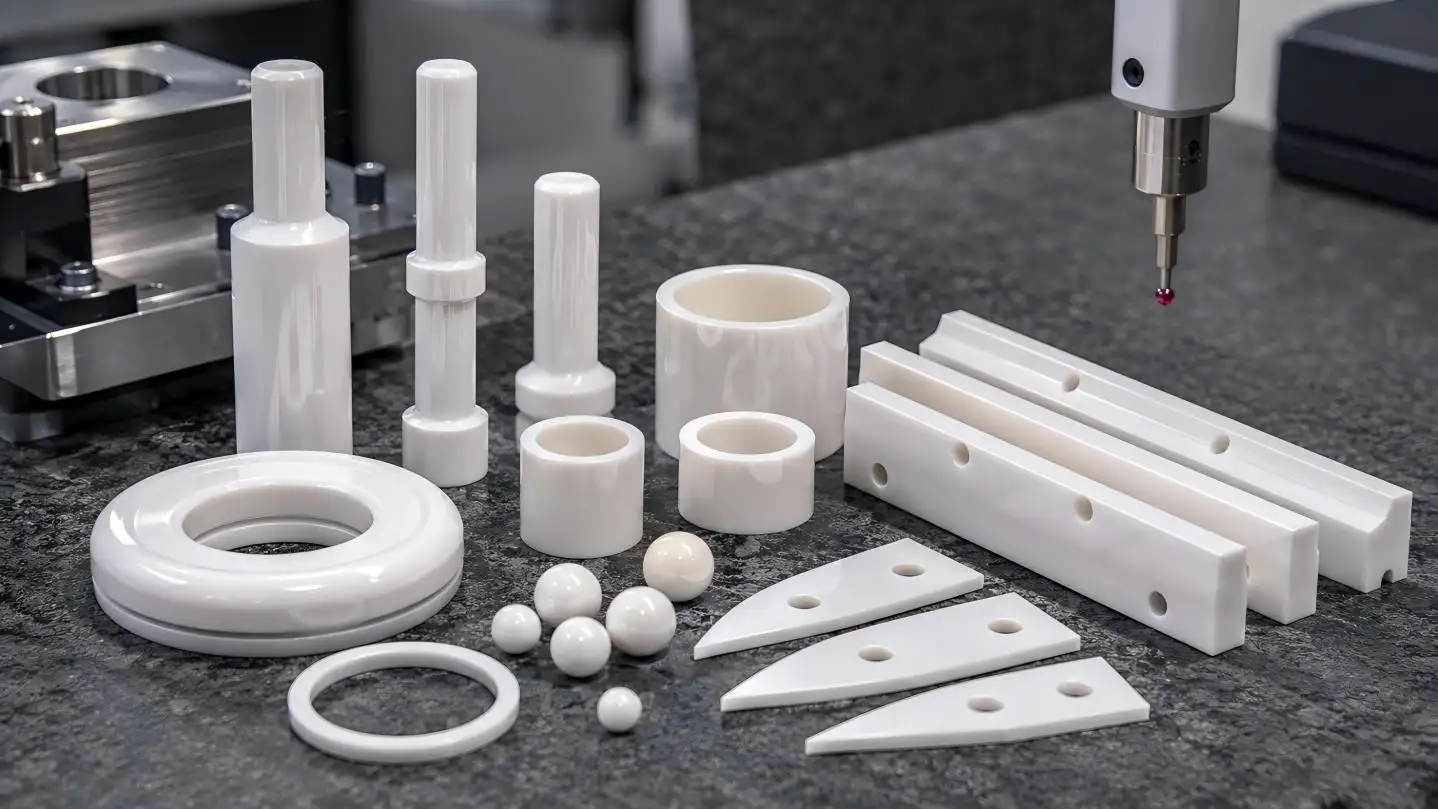
Just because a component is ceramic doesn’t mean that it’s “high performance”. It is so described, because its material, geometry, surface condition and manufacturing quality enable it to function reliably in the challenging operating conditions.
Advanced ceramics retain hardness, insulation and chemical stability at places where metals corrode, polymers deform or lubricated surfaces wear out quickly. But various ceramic materials will address various problems. The key to successful implementation is first to be able to pinpoint the failure mechanism and not to choose the material that has the most impressive datasheet.
Start at the point of Existing Failure.
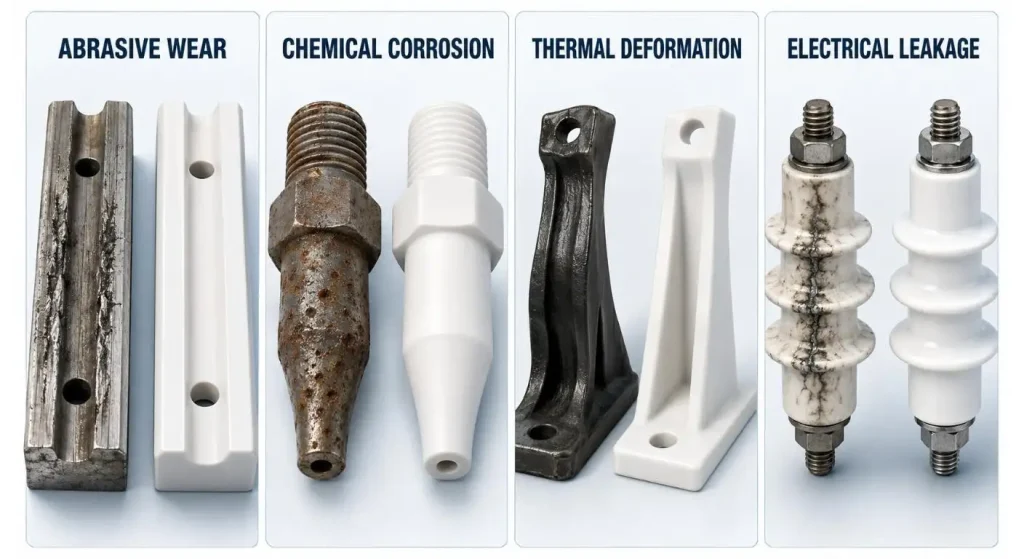
The best place to begin is the component that is causing the downtime, contamination or poor performance. Engineers should ascertain if the primary issues are abrasion, corrosion, electrical leakage, thermal distortion or if it is occurring due to repeated exposure to harsh cleaning.
Examples include:
- Worn abrasive production lines by metal guides
- The heat that causes polymer insulators to deform.
- Pump parts that are corroding in corrosive fluids.
- Parts not in accuracy after repeated cycles:
- Electrical parts tracking and/or outgassing.
- Semiconductor components that are sources of metallic contamination
These issues are a gauge of whether or not a meaningful advantage can be gotten from high performance ceramic parts. UPCERA’s high-tech ceramic products demonstrate the various properties of ceramics that can assist other critical application fields such as medicine, industrial equipment, electronics, fluid-control systems, and other demanding applications.
Assess material attributes to measure against Each Performance Requirement
No single ceramic material offers the maximum combination of toughness, hardness, thermal conductivity, electrical insulation, and corrosion resistance.This means there has to be a definite order of selection of materials.
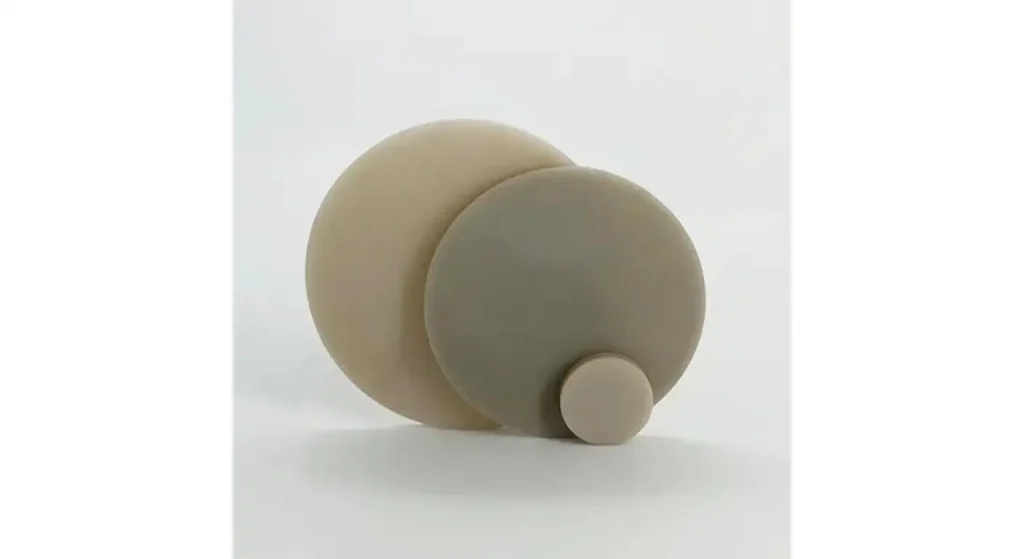
Alumina is a material with many applications as an electrical insulator, and as a resistant material to wear and high temperatures. Zirconia offers increased fracture resistance and can be used in precision components that require contact and/or intermittent impact resistance. Among its attributes silicon nitride has strength, low density and resistance to thermal-shock. Silicon carbide is a material with a high hardness, resistance to chemicals and dimensions at high temperatures. Aluminium nitride is useful in cases where both electrical insulation and heat dissipation is required.
After examining UPCERA’s variety of advanced ceramic materials, buyers can compare the grades for a particular application.
Evaluate Combined Loads, Not a Single Property
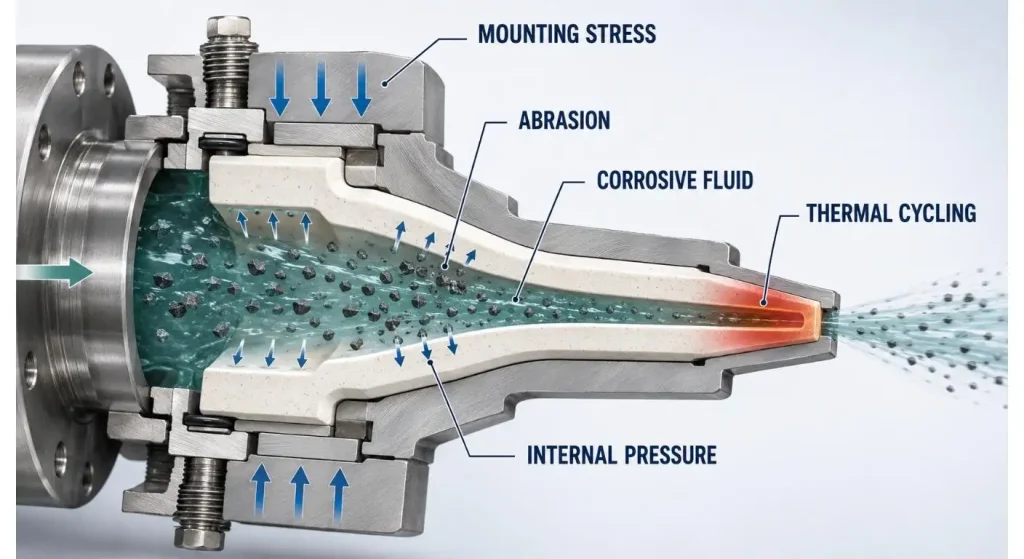
In most cases industrial components are subjected to more than one type of stress. Ceramic nozzle can be subjected to abrasive particles and pressure, and at the same time to chemical exposure and thermal cycling. Electrical insulator can be subjected to mechanical loading and be vibrating.
| Input Required | Information to Provide | Why It Matters |
| Temperature profile | Continuous, peak and cycling rate | Reveals heat and thermal-shock demands |
| Mechanical load | Direction, magnitude and impact frequency | Determines strength and toughness needs |
| Process medium | Fluid, gas, plasma or cleaning agent | Identifies corrosion and contamination risks |
| Wear condition | Motion, particles and mating surface | Guides hardness and surface selection |
| Electrical duty | Voltage, frequency and insulation distance | Defines dielectric requirements |
| Assembly method | Clamp, press fit, adhesive or brazing | Exposes installation stress |
| Service target | Required life and maintenance interval | Sets a measurable validation goal |
If the impact is the dominant factor then a material selected only for hardness can fracture. Even if a material has a high insulating value, it might not be an appropriate material if it will not conduct heat away from other electronic components. Similarly, a good high temp rating does not equate to the ability to stand up to a fast change in temperature.
The operating profile should specify the following:
- Ambient and/or highest temperatures
- The number of times the unit is heated and cooled in a year.
- Static, bending & impact loads
- Chemistry of fluids/gas.
- Size & concentration of abrasive particles.
- Electrical requirements – voltage and dielectric.
- Acceptable contamination
- Expected maintenance interval
The environment to be tested should be simulated in as close a manner as possible.
The geometry of ceramics can also be modified to suit the ceramic properties of interest.
In general, high performance ceramics are highly resistant to compressive forces and are weak in tension, in edge impact and stress concentration. Not all metal parts can be copied (directly) in ceramic.
Internal corners should be replaced with useful radii which are not sharp. Any abrupt thickness changes should be smoothed, as should holes, which should be set back from edges. Thin sections must be properly supported during manufacturing/assembly processes.
The tolerances in functional surfaces can be quite tight while the tolerances in non-critical areas should be economical. The custom ceramic parts and structures UPCERA can produce include bushings, nozzles, insulators, locating pins, ceramic-metal parts and drawing based complex structure.
Define Surface Quality Based on Function
Surface roughness is related to friction, seal, generation of particle, flow and electrical characteristics of fluids. A shiny surface might decrease sliding wear or contamination, and a deliberately ground surface might be suitable for a structural support.
Surface requirements should be specified only if the surface is for a specific purpose. Engineers should identify:
- Any surface that moves against another surface, such as a sliding surface.
- Sealing faces
- Fluid-contact passages
- Optical / sensing interfaces
- Bonding and metallization areas may require specific surface preparation.
- High-voltage surfaces
- Cleanroom-exposed surfaces
In precision grinding, lapping and polishing, it is necessary to avoid the occurrence of chips and subsurface damage. Thus, the advanced ceramic machining process is crucial for ceramic components, not just a mere dimensional finishing process.
Consider the Entire Assembly
Ceramics are often used with stainless steel, aluminum and polymers as well as with seals or adhesives. The different materials have different coefficients of thermal expansion and load-transfer behavior and load transfer characteristics.
Localized stresses can result from rigid clamping or too much interference. A compliant layer and/or controlled clearance and/or a brazed joint or engineered adhesive may provide a safer load distribution. It is also important in the design to avoid any hard metal surfaces coming into contact with edges of the ceramic during assembly.
Assessment of the ceramic part should be made in the entire system. Even a component which passes individual testing can be affected by housing distortion, misalignment or uneven fastener torque and fail.
Application-Based Testing to validate Performance.
`simulate as much as possible the most critical operating conditions and take measurements.
Validation can involve, depending upon the application:
- After multiple cycles, there is a wear rate.
- Strength after thermal exposure: Dielectric strength.
- Leakage under pressure
- Heat stability, dimensional stability properties after the heating process
- Immerse in chemicals and check for chemical resistance.
- Generation of particles in clean environment.
- Strength after assembling and vibrating.
Examine the ceramic part, and its mating parts, after testing. A wear pattern or discoloration, or even microcracks and contact marks can show a problem in the system before it fails completely.
Increase performance while keeping the manufacturability in mind.
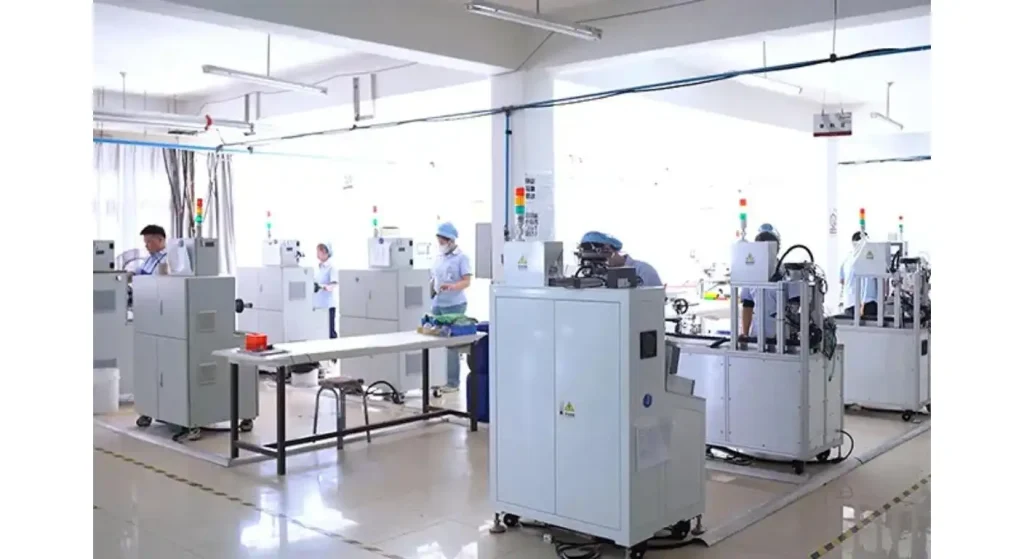
Not all ceramic grades are technically suitable for the production and the best production grade is not necessarily the most technically able. Total costs depend on geometry, batch volume, tooling, sintering behavior, time required for machining and inspection.
If a complex component is subjected to early design review, it may be possible to simplify the component, split it up into an assembly, or form it closer to its final shape. This minimises material removal and tool wear and reduces risk of tool rejection.
When evaluating a project, drawings, operating conditions, failure information, critical specifications and the expected quantity can be supplied to UPCERA by the customer.
Conclusion
When the problem to be solved is clearly defined with respect to equipment, the value of high performance ceramic parts is the greatest. Their success is based on the ability to correlate the material properties with the combined operating loads, geometry modification according to the ceramic properties and validation of the entire assembly.
A properly designed ceramic part has the ability to increase the maintenance cycle, increase process stability and reliably function in conditions where traditional materials break down.
FAQ
Q1. What makes a Ceramic Part High Performance?
It should provide a measurable level of reliability in the presence of harsh thermal, mechanical, chemical or electrical environment. If you choose the right materials, you don’t necessarily succeed in performance.
Q2. Which ceramic material is suitable for wear-resistant applications?
Silicon carbide, alumina are highly hard materials and Zirconia is hard and tough. Best choice is a function of load and impact/mating materials.
Q3. Are metal parts able to be replaced by high performance ceramic parts?
Sometimes, but direct replacement is not always advisable.May require geometry, clearance and mounting changes due to the differences of ceramics under tensile and impact loads.
Q4. Are there complex ceramic components that can be customized?
Yes. Yes. Features such as holes, steps, slots, threads, and special surfaces can be evaluated based on material, size, tolerance, geometry, and production quantity.
Q5. Which of the following is the best way to test a ceramic prototype?
Test in conditions of temperature, load, chemicals, motion, assembly etc. representative of the test. After testing, check the ceramic and mating parts to see if there is any damage.


In This Article
- 1 Start at the point of Existing Failure.
- 2 Assess material attributes to measure against Each Performance Requirement
- 3 Evaluate Combined Loads, Not a Single Property
- 4 The geometry of ceramics can also be modified to suit the ceramic properties of interest.
- 5 Define Surface Quality Based on Function
- 6 Consider the Entire Assembly
- 7 Application-Based Testing to validate Performance.
- 8 Increase performance while keeping the manufacturability in mind.
- 9 Conclusion
