 English
 中文
中文







Engineered Ceramic Parts: A Practical Material Selection Guide for Industrial Structural Components
Related Posts
Zirconia Sheet: The Practical Guide to Properties, Applications and Market Trends
April 23, 2026
Machining Ceramic With Practical Process Control: Reducing Risk Through Better Quality Management
April 13, 2026
Zirconia Tubes in Semiconductor Manufacturing: Precision Ceramics for Chip Production
June 22, 2026
Custom selection of engineered ceramic components is important. Metals are more straightforward, ceramics require understanding composition, microstructure, and processing. The four principal types of engineered ceramics—alumina, zirconia, silicon carbide, and silicon nitride—present unique solutions to different engineering problems. This guide offers a practical framework for structural and functional parts in optical, semiconductor, chemical, and industrial settings, excluding decorative uses.
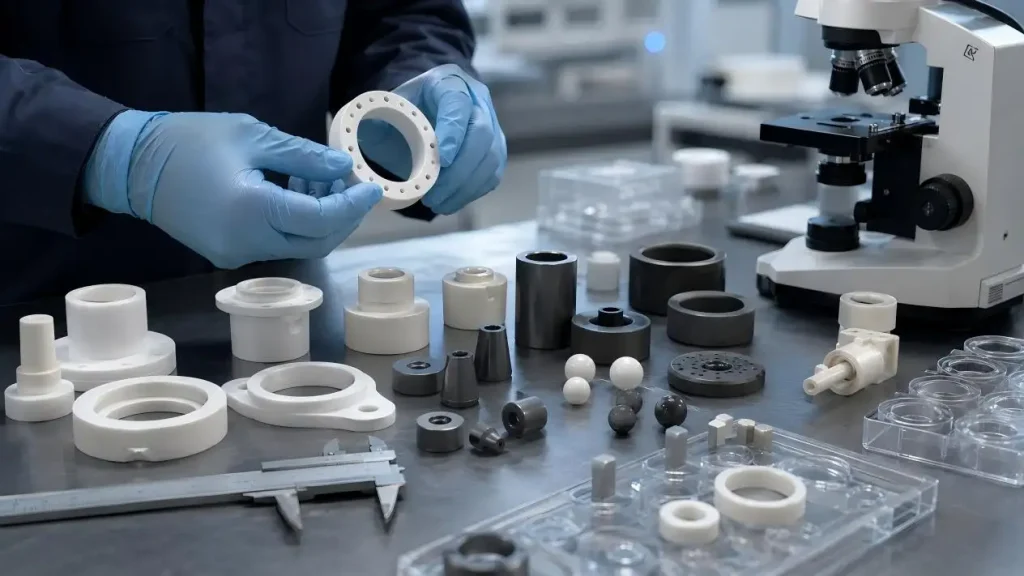
The Four-Question Framework for Selecting Engineered Ceramic Parts
Before comparing materials, ask four questions about your application:
• Dominant mechanical load? Impact, sliding wear, or static compression? Each load type demands a different ceramic.
• Thermal environment? Rapid temperature changes, high temperatures, dissipating/insulating heat? Key criteria are thermal conductivity and shock resistance.
• Chemical environment? Plasma, molten metals, acids, and alkalis? Corrosion resistance is a broad range and affects environment choice.
• Precision and cost? High tolerances may be uneconomical for general-purpose wear components.
Answering these questions makes high-level selections simple.
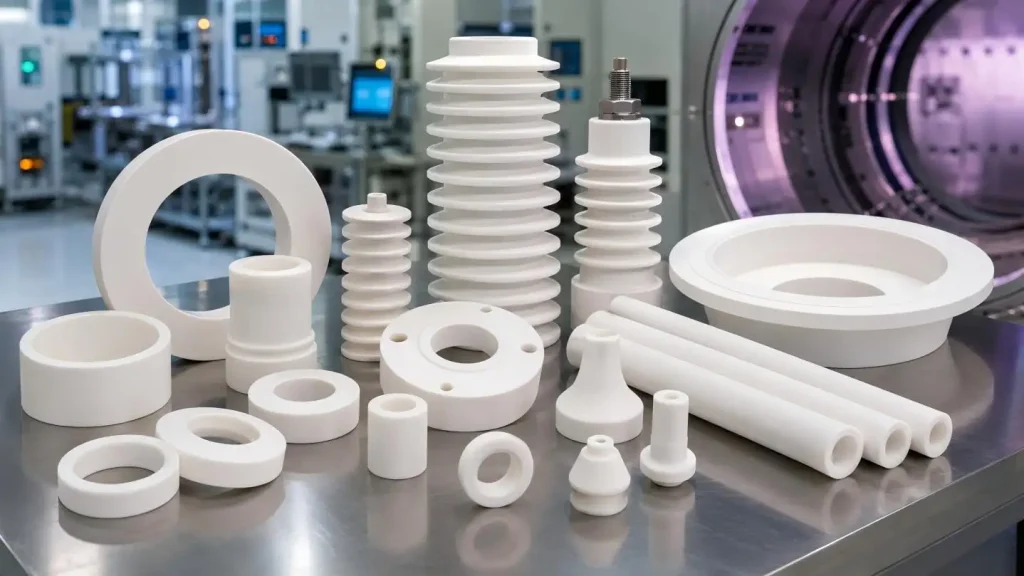
Alumina (Al₂O₃): The Workhorse of Engineered Ceramics
Alumina is by far the most popular technical ceramic and has a 29.7% market share of advanced structural ceramics. This popularity comes from a fair cost and useful all-around performance.
Characteristics of Alumina engineered ceramics include:
• Hardness: 1,400 - 2,500 HV. Even greater hardness is achieved with a higher purity of alumina (≥95.0% purity). 95% purity with hardness of >1,700 HV can be increased to >2,500 HV at 99.8% purity.
• Flexural strength: typically 250-400 MPa, which is enough for most structural applications.
• Fracture toughness: is 4-5 MPa·m¹/², which means alumina engineered ceramics are prone to chipping with impact or thermal shock.
• Thermal conductivity: is typically 24-35 W/m·K with room temperature moderate heat dissipation.
• Maximum service temperature: is 1,700°C in oxidizing environments.
• Electrical insulation: due to a volume resistivity of >10¹⁴ Ω·cm and dielectric strength of 15 kV/mm.
• Density: is 3.6-3.9 g/cm³ which is lighter than zirconia.
Best applications for alumina engineered ceramic parts:
• General industrial wear components (guides, pump seats, sealing rings)
• Electrical insulators and high-voltage components
• Semiconductor equipment chamber liners and nozzles
• Optical communication component housings
• Protection tubes and thermocouple sheaths
• Cost-sensitive structural applications where extreme toughness is not required
�� Limitations to consider: Alumina engineered ceramic parts stop being the obvious choice when the design is limited by crack resistance, impact loading, severe thermal shock, or very high heat-flow requirements.
Zirconia (ZrO₂): The Toughness Specialist for Demanding Engineered Ceramic Parts
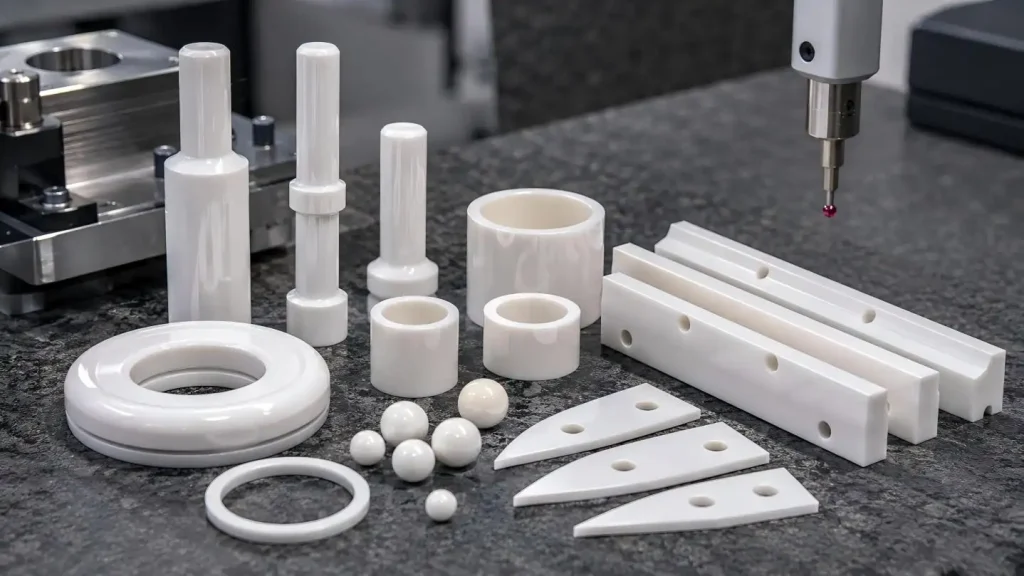
Zirconia is the choice when an engineered ceramic part needs to resist crack initiation and propagation more than any other material in this set. Often considered as "ceramic steel," zirconia outclasses alumina with a fracture toughness of 10 MPa⋅m¹/² and a flexural strength of 800 MPa.
When discussing properties of zirconia engineered ceramics, take into account:
• Fracture Toughness: 8 - 12 MPa⋅m¹/². Approximately 4 times as much of alumina.
• Flexural Strength: 550 - 800 + MPa. Some of the highest in engineering ceramics.
• Hardness: > 1,700 HV. While lower than alumina, it is still excellent for wear.
• Thermal Conductivity: 2.5 - 2.9 W/m⋅K. Less than 1/10th other ceramics. Excellent thermal insulator.
• Maximum Service Temperature: ~1,000°C for Y-TZP grades, constrained by phase stability.
• Density: 6.0 - 6.05 g/cm³. ~2 times alumina.
• Surface Finish: Superior grinding and polishing can produce surface roughness of Ra 0.02 μm.
Key Applications of Zirconia Engineered Ceramics:
• Components requiring high precision and considerable impact and fracture toughness.
• Wear resistant plungers, balls, and seals.
• Sliding Components of Optical Communication Ferrule and Sleeve.
• Industrial Cutters, Scissors, Cutting Blades. Bearing Components and Guide Rails.
• Thermal insulators focusing on high precision and low thermal conductivity.
�� Limitations: Zirconia engineered ceramics become less appealing when high thermal transfer or the highest continuous structural temperature are critical. Other than that, Zirconia is also more expensive than alumina and has a high coefficient of thermal expansion (~10.5⋅10⁻⁶/K).
Silicon Carbide (SiC): The Elite Engineered Ceramic Part for Extreme Environments
When faced with extreme conditions of wear resistance, low thermal expansion, chemical stability, and thermal stress, silicon carbide is the material of choice. SiC is also the highest in both hardness and conductivity of the heat among advanced ceramics.
Silicon carbide engineered ceramics possess great hardness, strength, and toughness.
Silicon Carbide offers the following:
• A hardness of 2,300- 2,800 HV, which is comparable to the hardness of diamond, and is far greater than alumina and zirconia.
• Flexural strength of 400-600 MPa, excellent retention at high temperature of 450 MPa at 1,000°C.
• Toughness measured in terms of fracture is 3 - 5 MPa·m¹/², and is also of another high performance ceramic, alumina.
• Superior thermal conductivity rated at 120 - 200 W/m·K, which is 5 to 6 times higher than alumina, makes SiC ceramic components ideal for heat management.
• Coefficient of thermal expansion: 4.0-4.5×10⁻⁶/K—significantly lower than both alumina and zirconia.
• Maximum service temperature: 1,600°C in oxidizing atmospheres.
• Thermal shock resistance: ΔT up to 500°C, among the best of all ceramics.
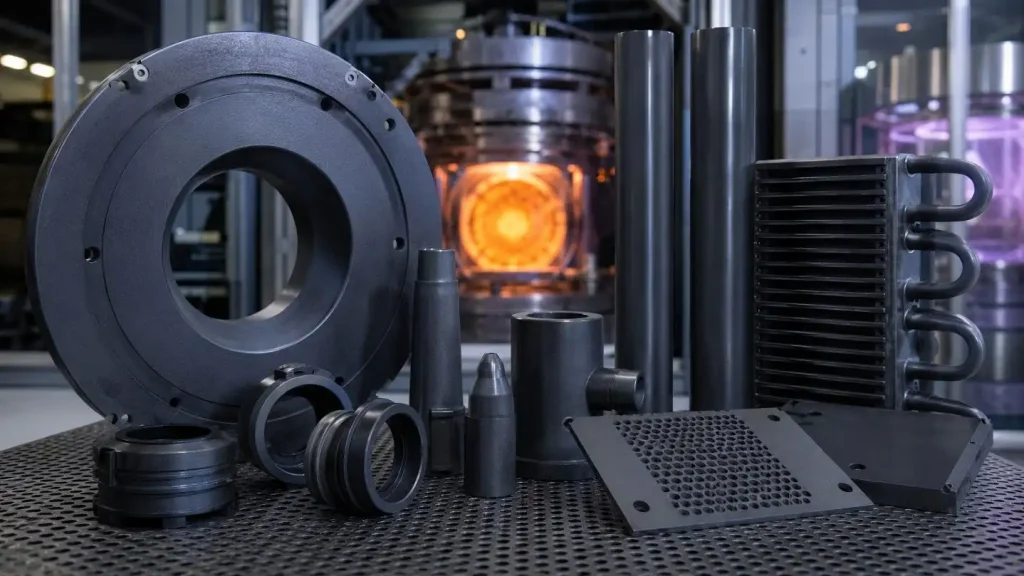
Best applications for silicon carbide engineered ceramic parts:
• Semiconductor processing chamber components exposed to aggressive plasma environments
• High-temperature furnace fixtures and process tubes
• Mechanical seals in aggressive chemical environments
• Nozzles and wear plates in abrasive slurry handling
• Heat exchangers and thermal management components
• Optical bases and precision reference structures requiring dimensional stability
�� Limitations to consider: SiC engineered ceramic parts are very difficult to machine, resulting in higher fabrication costs. In some grades (10²-10⁶ Ω·cm volume resistivity), the material is also electrically conductive, which restricts its use for electrical insulation.
Silicon Nitride (Si₃N₄): The Thermal Shock Resistant Choice for Engineered Ceramic Parts
Silicon nitride has the highest fracture toughness of all the technical ceramics and the best thermal shock resistance. Its low thermal expansion (2.8-3.2×10⁻⁶/K) is also ideal for semiconductor applications as it is similar to that of silicon.
Properties of silicon nitride engineered ceramic parts:
• Fracture toughness: 7-10 MPa·m¹/² (zirconia is 10-12 MPa·m¹/²)
• Flexural strength: 800-1,000 MPa (highest of common engineering ceramics)
• Hardness: 1,500-1,800 HV
• Thermal shock resistance: ΔT 550-600 (highest of all ceramics compared)
• Thermal conductivity: 25-40 W/m·K
• Max service temperature: 1,400°C
• Density: 3.2-3.3 g/cm³ (lightest engineered ceramic parts)
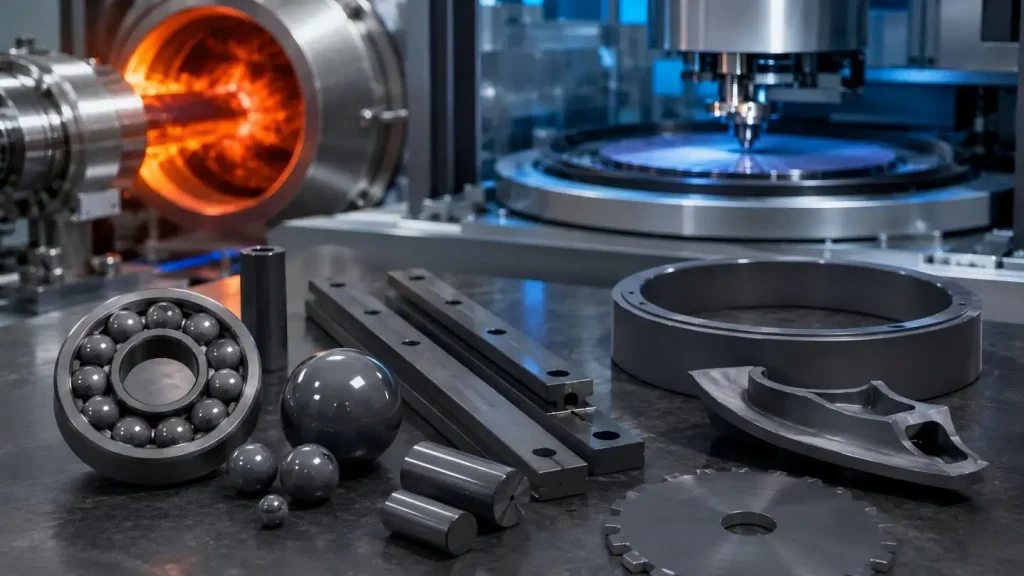
Best applications for silicon nitride engineered ceramics:
• Parts that undergo rapid thermal cycling
• Bearing balls and precision guide rails for fast moving machinery
• Turbine and high speed structural components
• Semiconductor focus rings and wafer blades
• Engineered ceramics for automotive powertrains
�� Also consider: silicon nitride engineered ceramics are expensive and more difficult to machine than alumina due to complex sintering.
ZTA (Zirconia Toughened Alumina): The Compromise of Toughness for Engineered Ceramic Parts
ZTA (Zirconia Toughened Alumina) is an excellent compromise in toughness and cost when zirconia cannot be justified, but tough alumina is required.
Highlighted Attributes of ZTA Engineered Ceramic Parts:
• Approximate hardness: 2,000 HV
• Approximate flexural strength: 450 MPa
• Approximate Fracture toughness: 5-6 MPa·m¹/² (in the range between alumina and pure zirconia)
• Approximate thermal conductivity: 18 W/m·K
• Estimated maximum service temperature: 1,500°C
Ideal uses for ZTA Engineered Ceramic Parts:
• Components that are designed for wear and require toughness that is better than alumina
• Components of cooling mechanisms used in semiconductor apparatus
• Where high density of pure zirconia is a drawback
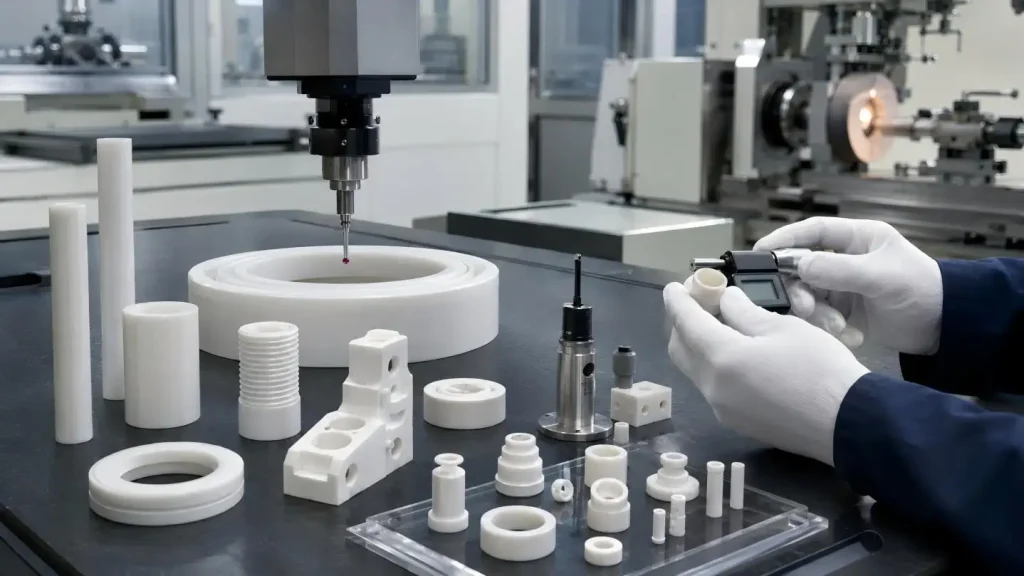
UPCERA Engineering & Precision Manufacturing for Engineered Ceramic Parts
Being a highly specialized manufacturer of high-performance Engineered Ceramic Parts, UPCERA combines precision machining with an exceptional degree of control and mastery of the materials utilized to produce parts with a high degree (micron level) of precision demanded by today's industrial applications.
Focusing on Engineered Ceramic Parts that are based on zirconia and alumina, UPCERA provides solutions for structural, electrical, and high wear applications.
1. Key Technical Data from Precision Manufacturing
• Dimensional length control: ≤300 mm with high repeatability for Engineered Ceramic Parts
• Outer diameter with controlled geometry and concentricity: ≤150 mm
• Surface roughness: Ra 0.02 - 0.2
• Wall thickness: 0.1 mm
• Precision in roundness: 0.002 mm
• Precision in concentricity: 0.002 mm
• Precision in straightness: 0.004 mm
• Precision in perpendicularity: 0.005 mm
2. Engineering Advantages of Engineered Ceramic Parts
• Mechanical resistance and thermal cycling: High structural integrity
• Wear-resistant: Design extends service life in friction-intensive Engineered Ceramic Parts applications
• Chemical stability: Reassures reliability in corrosive and reactive environments
• Electrical insulation: Safety in high-voltage systems
• Accuracy of complex geometries: Ability to design ceramics that are threaded and thin-wall with many features
With these capabilities, UPCERA Engineered Ceramic Parts serve the aerospace, semiconductor, automation, and medical fields. Parts need to be highly precise and stable for long periods of time.
FAQs
Q: Which material has the best toughness?
A: Zirconia (ZrO₂) has the highest fracture toughness (8–12 MPa·m¹/²) and is therefore excellent for use in parts that are impacted.
Q: Which ceramic material is the best for thermal shock?
A: Silicon nitride (Si₃N₄) is the best for thermal shock, as it can stand up to ΔT of 600°C. Si3N4 is therefore the best material for thermal cycling.
Q: What are the reasons for selecting silicon carbide over alumina?
A: Select SiC for use in extreme wear, high thermal conductivity, or highly chemical/plasma reactive environments.
Q: What is ZTA and what are the benefits?
A: ZTA is a combination of zirconia and alumina and is a compromise between the toughness of alumina and the price of pure zirconia.
Q: Can you achieve sub-micron tolerances with engineered ceramics?
A: Yes, tolerances of 0.01 mm (and even <0.005 mm) can be achieved with diamond grinding and other advanced machining processes.


In This Article
- 1 The Four-Question Framework for Selecting Engineered Ceramic Parts
- 2 Alumina (Al₂O₃): The Workhorse of Engineered Ceramics
- 3 Zirconia (ZrO₂): The Toughness Specialist for Demanding Engineered Ceramic Parts
- 4 Silicon Carbide (SiC): The Elite Engineered Ceramic Part for Extreme Environments
- 5 Silicon Nitride (Si₃N₄): The Thermal Shock Resistant Choice for Engineered Ceramic Parts
- 6 ZTA (Zirconia Toughened Alumina): The Compromise of Toughness for Engineered Ceramic Parts
- 7 UPCERA Engineering & Precision Manufacturing for Engineered Ceramic Parts
Related Posts
Zirconia Sheet: The Practical Guide to Properties, Applications and Market Trends
April 23, 2026
Machining Ceramic With Practical Process Control: Reducing Risk Through Better Quality Management
April 13, 2026
Zirconia Tubes in Semiconductor Manufacturing: Precision Ceramics for Chip Production
June 22, 2026
