 English
 中文
中文







Detailed Guide to Structural Ceramic Forming and Firing Processes

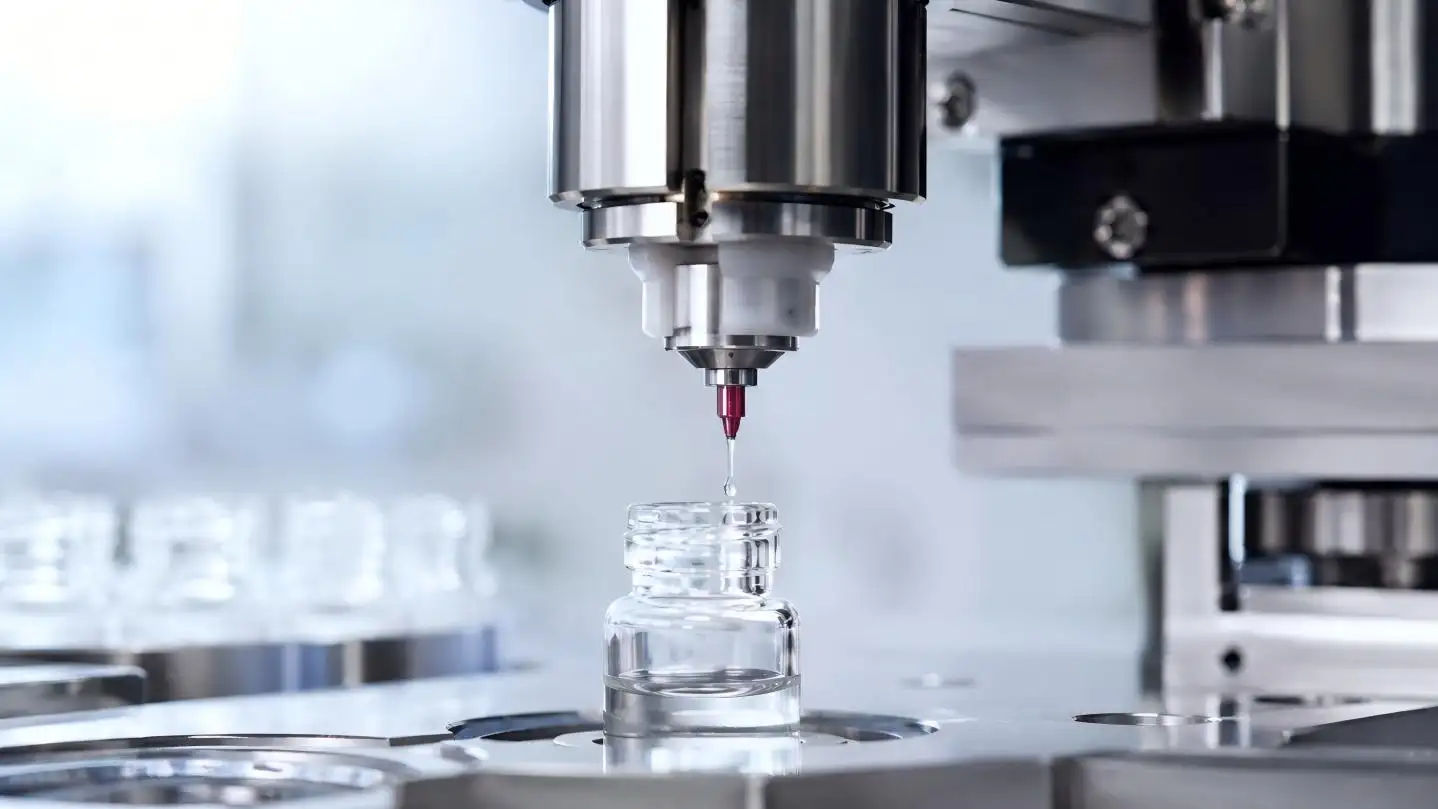
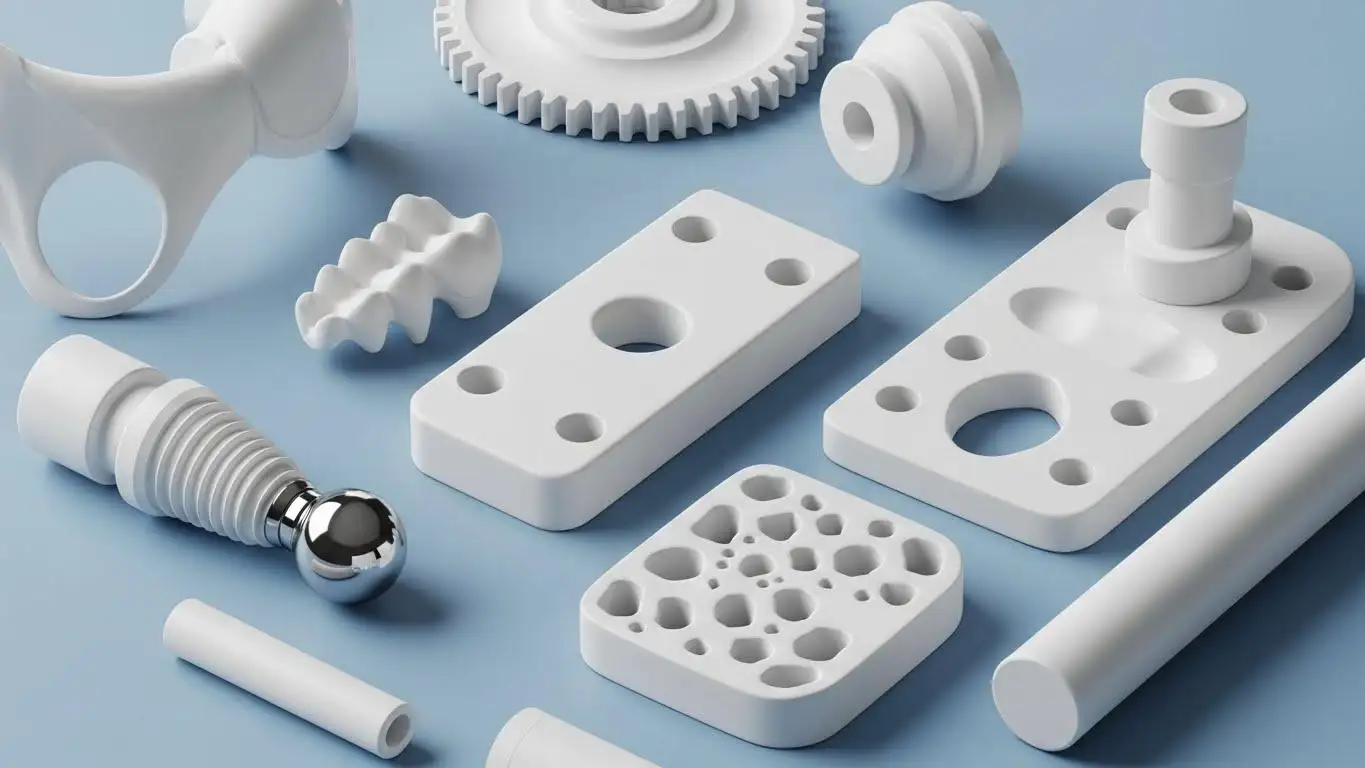
Most structural ceramic formulations contain no clay. Because the raw materials have no inherent plasticity and cannot meet forming requirements directly, dedicated binders must be added when preparing the feedstock. Binder type and dosage depend on multiple factors, including the forming process, the physical and chemical properties of the raw material, the dimensions and structural complexity of the ceramic product, and the applicable production tooling. Tooling must also be customized according to the sintering shrinkage factor to meet mass-production forming requirements. UPCERA's principal mass-production methods include ceramic injection molding, isostatic pressing, dry pressing, and hot-pressure casting.
1. Requirements for Selecting Ceramic Forming Binders
Binders used for structural ceramic forming must meet four key requirements throughout forming, debinding, and sintering:
They must provide adequate bonding performance, maintain powder flowability during forming, improve green-body integrity and mechanical strength, and support handling and machining requirements.
They must volatilize and decompose completely during high-temperature sintering, leaving no residue—or only trace impurities—so that the physical and chemical properties of the finished ceramic are not affected.
They must be suitable for workshop-scale mass production, easy to prepare and use, and free from corrosive constituents that could damage equipment or contaminate raw materials.
They must be chemically stable and must not react with zirconia, alumina, or other ceramic raw materials or negatively affect the mechanical, insulating, corrosion-resistant, or other properties of the finished product.
2. Key Considerations in Ceramic Forming-Tool Design
Each forming process requires purpose-designed tooling. Qualified tooling must deliver compliant product geometry, specified dimensional accuracy, convenient operation, high production efficiency, wear resistance, and a long service life. Structural design, mechanical calculations, and precision machining must therefore be completed in advance. Because ceramic green bodies undergo predictable volumetric shrinkage during high-temperature firing, the tooling design must account for linear shrinkage and include the required dimensional allowance. The core calculation is:
Tool linear dimension = f × required finished ceramic dimension
Coefficient conversion: f = a/b, where a is the linear dimension of the green body before firing, b is the linear dimension of the finished ceramic after firing, and f is the ceramic linear shrinkage factor.
3. Comprehensive Guide to Dry Pressing
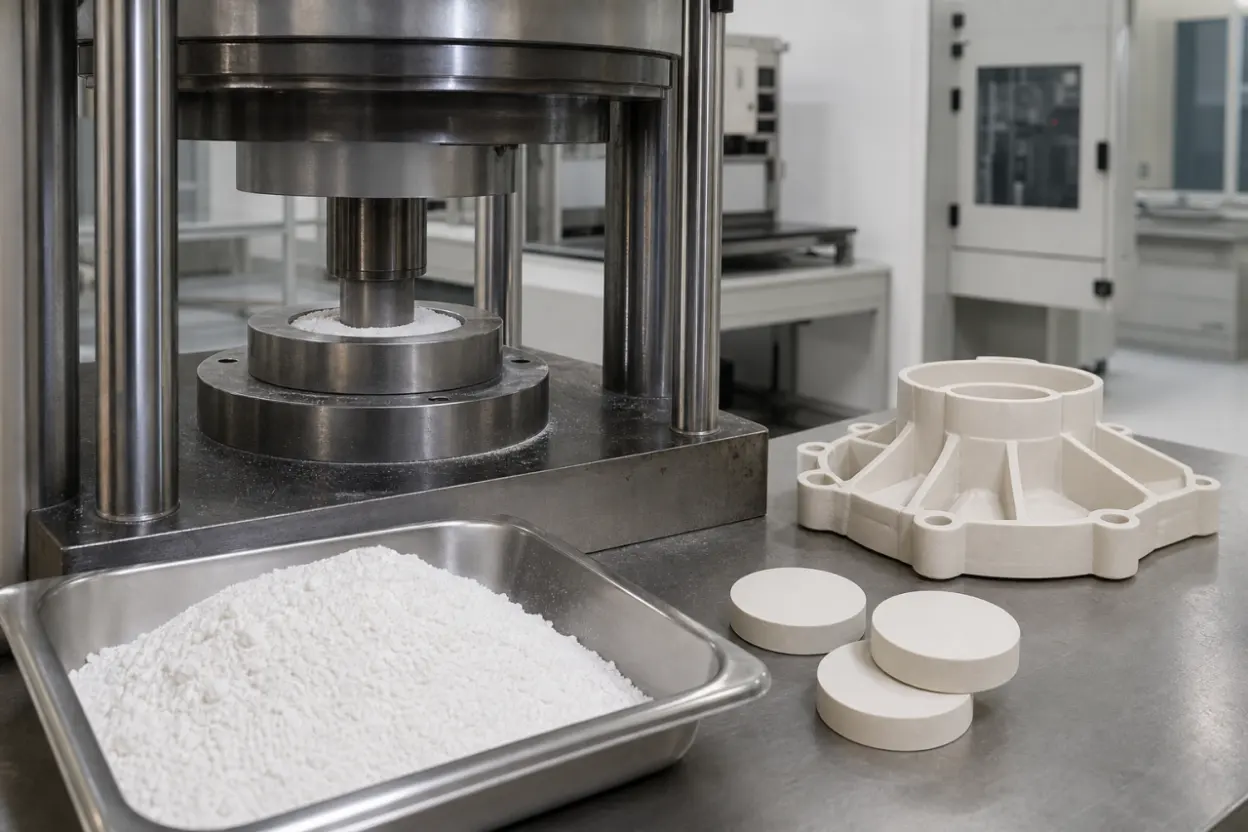
Dry pressing is the most widely used forming process for industrial structural ceramics. It is suitable for automated mass production, has a simple process, produces uniform firing shrinkage, and carries a low risk of finished-part deformation. It is best suited to conventional ceramic parts with simple geometries, such as discs, and without special holes, grooves, thin walls, or ribs. However, the process requires highly accurate, wear-resistant tooling and has relatively strong application limitations. Powder moisture content is a critical quality-control point in dry pressing, with a standard range of 4%-8%. Before mass production, a suitable binder must be added and the powder granulated to improve flowability, strengthen particle bonding, and increase green-body compressive strength.
3.1 Key Process-Control Points for Dry Pressing
(1) Pressing method
Pressing is divided into single-sided and double-sided modes, which directly affect density uniformity. With single-sided pressing, force is applied from only one side: density is higher near the loaded end and lower at the far end, creating a large density difference within the green body. With double-sided pressing, force is applied simultaneously from both ends. The two ends become well compacted while density at the center is slightly lower, but overall uniformity is better than with single-sided pressing.
(2) Forming pressure
Forming pressure directly determines green-body density and firing shrinkage. If pressure is too low, the green body contains more pores and exhibits greater firing shrinkage. Conventional industrial dry-pressing pressure is controlled at ≤ 2 MPa. Excessive pressure can readily cause delamination, surface cracking, sticking during demolding, and chipped edges or corners.
(3) Pressing speed and holding time
If pressure is applied too quickly, air trapped between powder particles cannot escape, directly causing defects such as green-body delamination, uneven internal and external density, and residual internal bubbles. Mass production requires slow, uniform pressing combined with a fixed pressure-holding time to evacuate internal air and ensure uniform density throughout the green body.
4. The Three Main Stages of Ceramic Firing
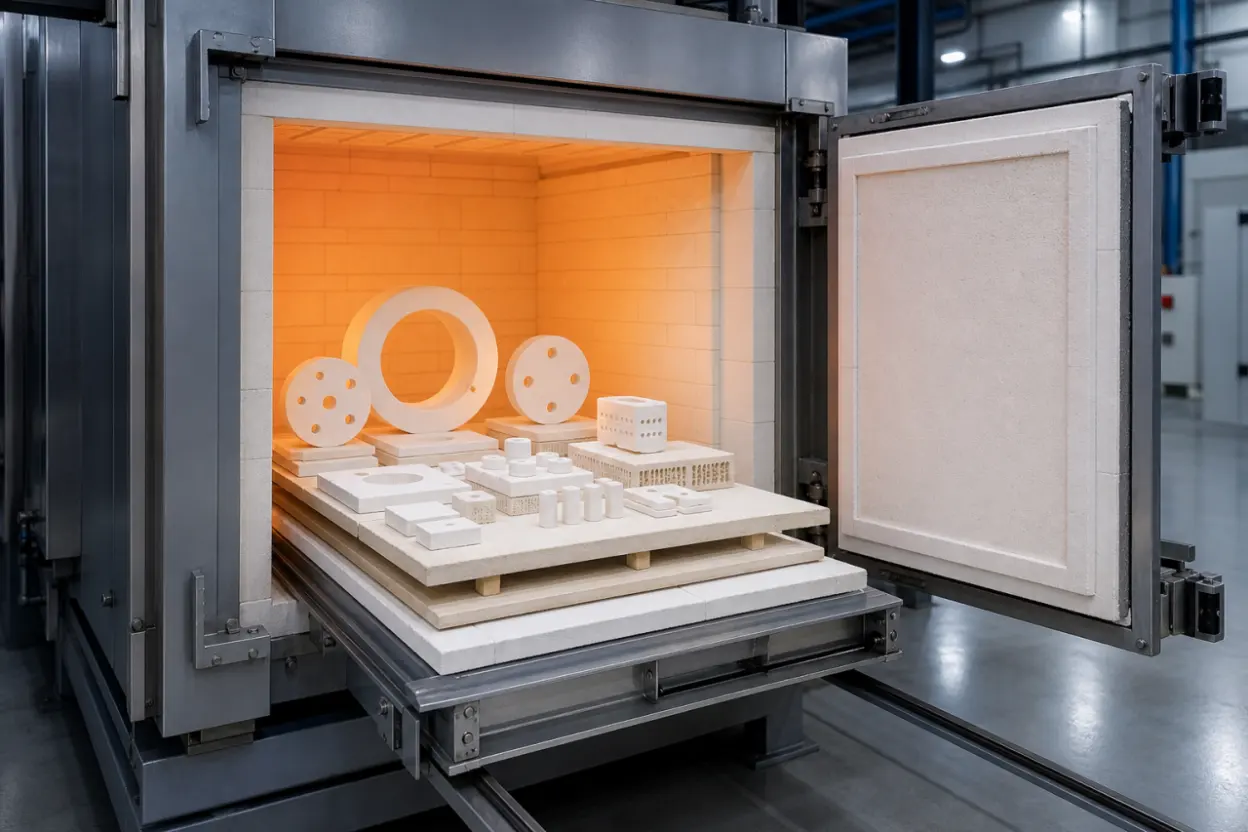
Firing is the core process in which a formed ceramic green body is placed in a high-temperature kiln and densified through heat. The prescribed physical and chemical reactions occur, enabling the finished product to achieve the required mechanical, electrical, corrosion-resistant, and other service properties. A complete firing cycle comprises heating, temperature holding, and cooling. The process parameters for each stage must be controlled independently and must not be adjusted arbitrarily.
4.1 Heating Stage
This stage extends from room temperature to the specified maximum firing temperature. Its main functions are the evaporation of free moisture, high-temperature volatilization of organic binders, removal of crystal water and structural water, decomposition of carbonate constituents, and—in zirconia ceramics—the associated high-temperature crystal-phase transformation. Except for the phase transformation, these processes release large quantities of gas. Rapid heating is therefore strictly prohibited at this stage because it can cause porous or loose green bodies, overall deformation, edge cracking, and internal cracks across a production batch.
4.2 Holding Stage
The holding stage is the decisive step in determining the properties of the finished ceramic. The constituents within the green body fully undergo their physical phase transformations and chemical reactions, ultimately forming a dense ceramic matrix with the required performance. Each ceramic raw material has its own optimum firing-temperature range, so the maximum furnace temperature and holding time must be strictly controlled. When held within the proper range, the fired product is dense and impermeable, has a uniform grain structure, and delivers optimal mechanical and electrical properties. Firing above the specified temperature range increases porosity and substantially reduces strength, insulation performance, and wear resistance.
4.3 Cooling Stage
This stage covers controlled cooling from the maximum firing temperature to room temperature. Physical and chemical changes such as liquid-phase solidification, grain crystallization, and material phase transformations occur during cooling. The cooling method and rate directly determine the phase composition and internal microstructure of the finished product and ultimately affect key properties such as wear resistance, strength, and dimensional stability. Ceramic parts with special geometries or thin walls require a staged, slow-cooling process.
5. Comparison of Forming Process Parameters
| Process | Key Process Parameters | Suitable Products | Process Considerations |
| Dry pressing | Powder moisture content 4%-8%; forming pressure ≤ 2 MPa; single-sided or double-sided pressing | Small ceramic parts with simple geometries, such as discs and blocks, without special features | Strictly control pressing speed and provide adequate holding time to prevent green-body delamination and cracking |
| Injection molding | Suitable for precise complex geometries; customized tooling must account for shrinkage | Complex precision ceramic parts with small holes, blind holes, thin walls, or multiple ribs | Thick-walled parts have a higher debinding risk; control binder ratio to prevent bubbles and cracking |
| Isostatic pressing | Uniform pressure applied in all directions, producing highly consistent green-body density | Medium-to-large load-bearing structural ceramic blanks | Longer production cycle and relatively high production cost for small batches |
| Hot-pressure casting | Molten casting based on a paraffin binder system | Small-to-medium special structural ceramics with regular geometries | Long debinding time and possible trace binder residue |
Frequently Asked Questions (FAQ)
Q: Must binders be added when forming structural ceramics?
A: Most clay-free structural ceramic raw materials have no plasticity and cannot be formed directly, so a suitable binder must be added. Only certain modified plastic powders may be processed without a binder, depending on the specific forming method.
Q: Why must the ceramic linear shrinkage factor be considered when determining tooling allowance?
A: Ceramic green bodies undergo predictable shrinkage during high-temperature firing, and the shrinkage ratio varies by material. Without an appropriate tooling allowance, finished parts will be undersized and may exceed tolerance limits. Calculating dimensions using the coefficient f = a/b helps ensure that finished-part dimensional accuracy meets specification.
Q: Is double-sided pressing better than single-sided pressing in dry pressing?
A: Double-sided pressing provides better overall density uniformity and is suitable for high-precision, load-bearing ceramic components. Single-sided pressing is simpler and more efficient and is appropriate for mass production of ordinary, lower-precision ceramic discs. The method should be selected according to the application.
Q: Can the heating rate be increased throughout the ceramic firing cycle?
A: No. During the initial heating stage, binders, moisture, and decomposition gases are released intensively. Rapid heating can trap pressure and cause cracking or a loose structure in the green body. The heating rate may only be adjusted within compliant limits during the middle and later stages, according to the material.
Q: How should the four major forming processes be selected?
A: Choose dry pressing for very simple thin discs and standard blocks; injection molding for miniature, complex, thin-walled parts; isostatic pressing for medium-to-large, high-density blanks; and hot-pressure casting for small-to-medium special ceramic parts with regular geometries. The final selection should consider production volume, accuracy requirements, and structural complexity.
Process Selection and Customization Support
Whether your product is a simple block or sheet-type conventional ceramic component, or a complex, thin-walled, high-precision structural ceramic part requiring dry pressing, injection molding, isostatic pressing, or hot-pressure casting, we can select the forming process according to its structure, material type, dimensional tolerances, and production-volume requirements. We can also optimize binder ratios and firing parameters, calculate tooling allowances, and provide a complete mass-production process solution.


