 English
 中文
中文







Zirconia Ceramic Tube: How To Pick Size, Tolerance, And Finish



Zirconia Ceramic Tube selection becomes much easier when you treat it as a drawing-driven decision about size, tolerance, and finish, not just a material choice.
1) Start With the Application: What the Tube Must Actually Do
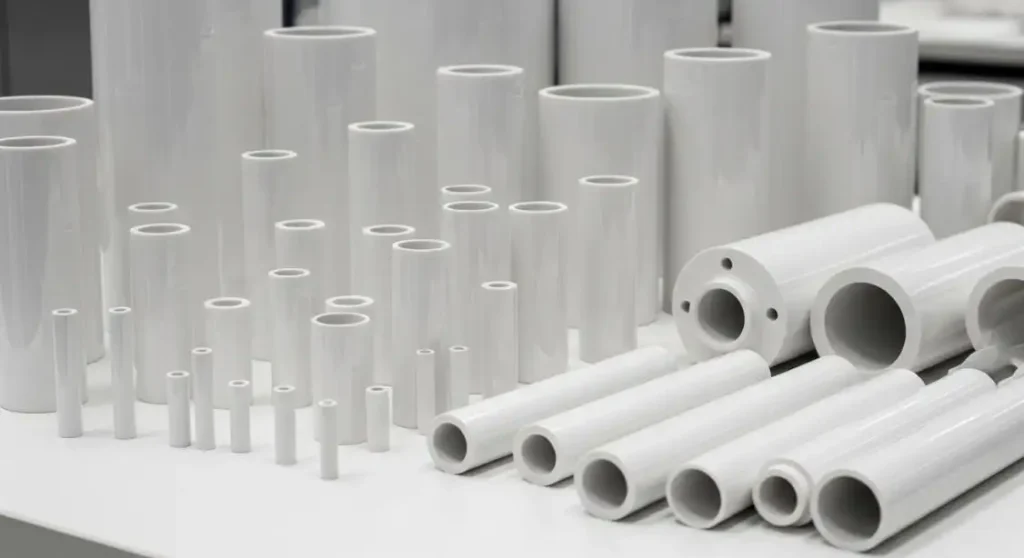
From UPCERA’s manufacturer perspective, a Zirconia Ceramic Tube is usually chosen for one of three reasons: stable performance in heat, strong wear resistance in sliding contact, or reliable corrosion resistance where metals age too fast. But the “best” tube is always the one that matches the working method.
Before you pick dimensions, clarify the function in one sentence:
• Is the tube a protective sleeve (insulation, barrier, or shielding)?
• Is it a wear part (guiding, locating, rubbing, sealing support)?
• Is it a flow path (liquid, gas, slurry, powder, or fiber)?
Those three use cases lead to different priorities. Protective sleeves care more about straightness and safe edges. Wear parts care more about ID/OD tolerance and surface finish. Flow paths care more about bore quality and cleanliness.
2) Pick Size the Practical Way: OD, ID, Length, and Straightness
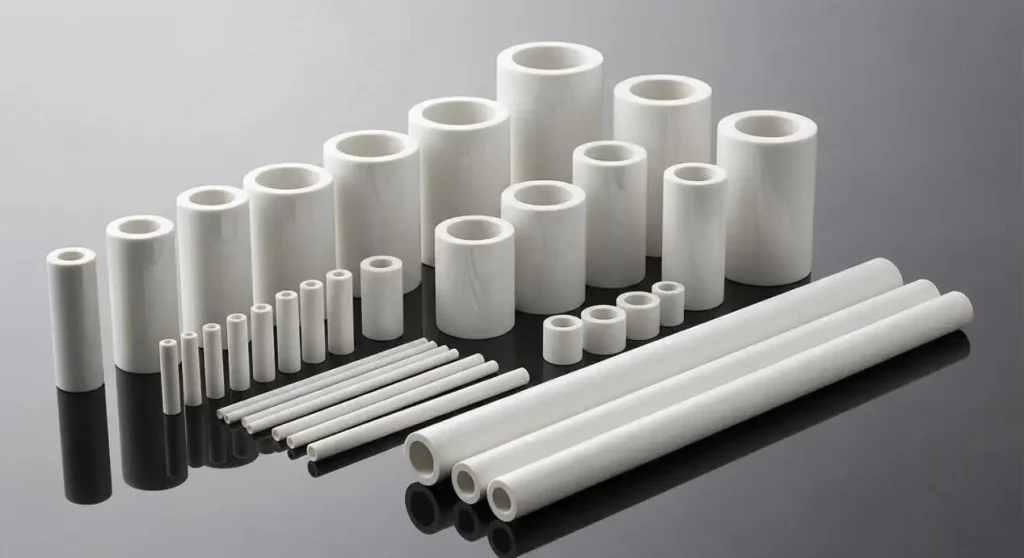
A Zirconia Ceramic Tube is defined by OD (outer diameter), ID (inner diameter), and length. But what decides success is how those sizes behave in assembly. In manufacturing, we often see “correct nominal size” still fail because the locating surface, wall thickness, or straightness expectation was not defined early.
OD and ID: Decide Which Surface “Locates“ the Part
Ask one question: Which surface centers the tube in the system—OD or ID?
• If the tube is mounted into a metal housing, the OD often locates the part.
• If the tube runs on a shaft, pin, or wire, the ID often locates the part.
Once the locating surface is chosen, you can design the other surface more freely. This reduces cost and prevents over-tolerancing.
To make this concrete, here is a common zirconia sleeve/tube-style example used in precision alignment parts:
• OD 3.2 ± 0.02 mm
• ID 2.493 ± 0.001 mm
• Length 11.4 ± 0.1 mm
Notice what this tells a beginner: when ID is the functional locating feature, it is often held much tighter than OD.
Practical sizing tips used in many assemblies:
• Keep a realistic wall thickness for strength during handling and installation
• Avoid very sharp transitions at the ends; add a small lead-in or chamfer
• If the tube is long and slim, plan for straightness control (and protective packaging)
• If the tube must slide over a pin or wire, confirm whether the pin is a running fit or a location fit
At UPCERA, we advise customers to send mating-part information early. A correct OD/ID relationship often matters more than hitting an isolated nominal number.
3) Understand Tolerance: What to Control, and What to Relax
Beginners often request “tight tolerance everywhere.” In ceramics, that approach can increase cost without improving performance. The smarter approach is to control only what affects fit, sealing, alignment, or wear—then relax the rest.
Three Tolerances That Usually Matter Most
For most Zirconia Ceramic Tube projects, these tolerance targets drive results:
• Locating diameter tolerance (OD or ID) to ensure stable assembly
• Roundness and concentricity to prevent uneven wear and vibration
• Length tolerance and end squareness when the tube seats against a shoulder
If the tube is used as a wear sleeve, small deviations in roundness or concentricity can concentrate contact on a narrow line. That is how “good material” becomes “short service life.”
Typical Tolerance Expectations (Use As a Reference, Not a Promise)
Manufacturing capability depends on geometry, wall thickness, length, and finish requirements. But in real industrial practice, you will often see patterns like this:
• Critical IDs can be specified to ±0.001 mm in precision alignment tube applications
• ODs may be looser, such as ±0.02 mm, if OD is not the primary locating surface
• Length tolerance may be wider, such as ±0.1 mm, unless the tube must hard-stop on a shoulder
To keep your specification realistic:
• Tighten the tolerance only on the functional diameter
• Use a wider tolerance on non-mating features
• Specify concentricity/roundness when rotation, sliding, or sealing is involved
If you are unsure, UPCERA can help convert your application into a practical tolerance stack-up, so the drawing protects performance without creating unnecessary machining steps.
4) Choose Finish Like an Engineer: Roughness, Polishing, and Edge Treatment
Surface finish is not only about appearance. In a Zirconia Ceramic Tube, finish directly affects friction, wear rate, particle shedding, cleaning difficulty, and sealing behavior.
Match Finish to Contact Type
A simple rule works well:
• Sliding or rubbing contact: choose a finer finish to reduce abrasive wear
• Fluid or powder flow: choose a smoother bore to reduce buildup and turbulence
• Adhesive or coating processes: confirm whether a slightly rougher surface is needed for bonding
Also, do not ignore end treatment. Many field failures start at the ends:
• Add a chamfer or radius to reduce chipping risk during installation
• Specify edge quality if the tube meets O-rings, gaskets, or fragile components
• If cleaning is critical, specify how the tube should be handled after polishing
A well-chosen finish can reduce maintenance time, not just improve lab results.
5) Confirm the Zirconia Grade and the Service Environment
“Zirconia” is not one single material. The most common engineering zirconia is stabilized zirconia (often yttria-stabilized), designed to keep strength and toughness stable in demanding conditions.
From a manufacturer viewpoint, the grade decision should follow the environment:
• Temperature range and thermal cycling pattern
• Contact mode (static load, sliding wear, impact risk)
• Chemical exposure (acids/alkalis/solvents, or cleaning agents)
• Contamination sensitivity (medical, lab, semiconductor, or precision dosing)
If the tube will run in a mixed-material assembly, also consider how the mating material behaves. A hard ceramic can “win” the wear battle, but it may accelerate wear on softer counterfaces unless finish and alignment are well managed.
6) A Beginner-Friendly Ordering Checklist + CTA
To source a Zirconia Ceramic Tube smoothly, focus on what the factory must control. At UPCERA, the fastest path to a correct quote and stable production is a clear drawing plus a short application note.
Here is a practical checklist you can copy into your inquiry:
• OD / ID / length, and which surface is the locating surface
• Critical tolerances (diameter, concentricity/roundness, length/end squareness)
• Surface finish requirements (especially for bore polishing or sliding contact)
• Edge treatment (chamfer/radius) and any “no-chip” handling needs
• Working environment (temperature, media, wear mode, cleanliness requirements)
• Estimated quantity and inspection level (sample, pilot, or repeat production)
CTA (Call-to-Action)
If you are selecting a Zirconia Ceramic Tube and want to avoid over-specifying—or under-specifying—your drawing, contact UPCERA with your tube dimensions, mating-part method (OD-fit or ID-fit), and the working environment. We will recommend a practical tolerance and finish package, propose a manufacturable structure, and support you with inspection guidance so your first batch performs like the final batch.


In This Article
- 1 1) Start With the Application: What the Tube Must Actually Do
- 2 2) Pick Size the Practical Way: OD, ID, Length, and Straightness
- 3 3) Understand Tolerance: What to Control, and What to Relax
- 4 4) Choose Finish Like an Engineer: Roughness, Polishing, and Edge Treatment
- 5 5) Confirm the Zirconia Grade and the Service Environment
- 6 6) A Beginner-Friendly Ordering Checklist + CTA
