 English
 中文
中文







How ZrO₂ Ceramics Are Made: From Powder to Precision Structural Components
Related Posts
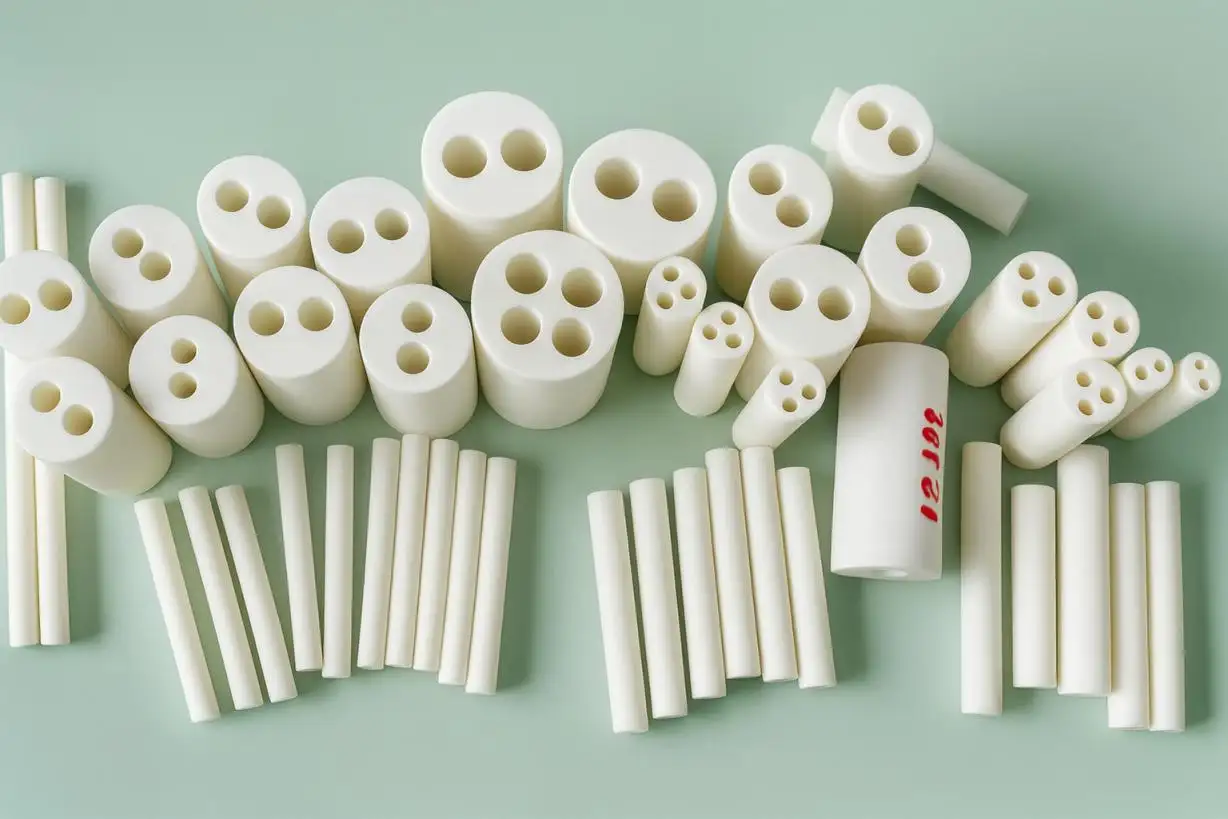
Advancements in manufacturing have popularized zirconia ceramics, which are comprised of zirconium dioxide (ZrO₂), and have invoked the term "ceramic steel." Zirconia ceramics have impressive mechanical properties, such as toughness and strength, in addition to excellent resistance to wear, corrosion, and thermal shock. Remarkably, raw ceramic powders have the ability to be manufactured into structural components that are precision capable of sustaining the most demanding environments of the aerospace, medical, and semiconductor fields.
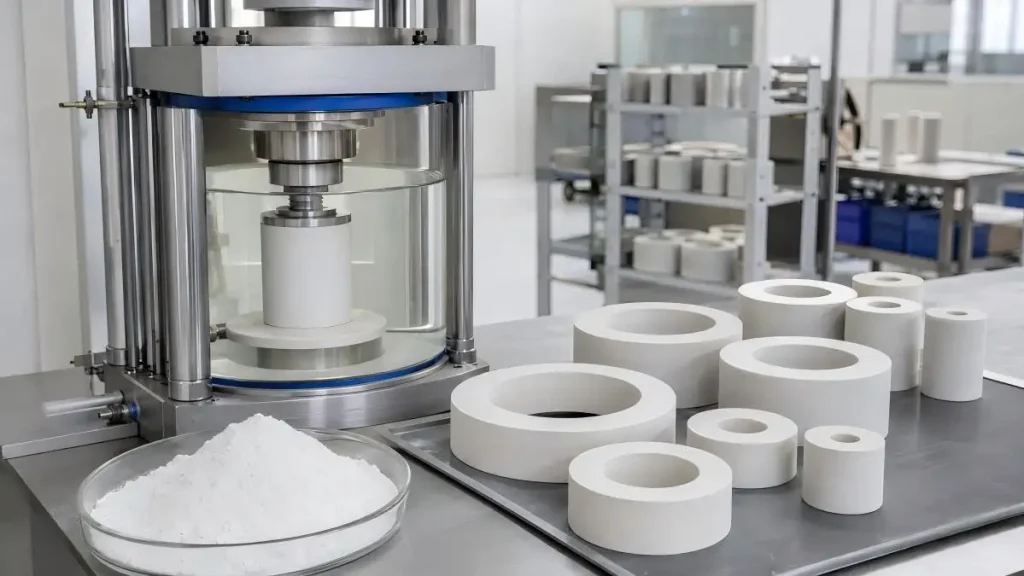
ZrO₂ ceramic manufacturing as a whole (from powder selection to the post production quality assurance of Ceramics) is described in the following pages, and showcases the advanced manufacturing abilities by companies such as UPCERA, that offer the precision, tolerances, and intricate geometries that are extensively demanded by a multitude of fields.
Step 1: Choosing and Processing High Purity Ceramics Powders
Powder is the starting point for all ZrO₂ ceramics. Not just any powder, but high purity, carefully engineered zirconia powder with a controlled particle size and shape.
•Yttria-stabilized zirconia (Y-TZP) is the industry standard: Y-TZP is the most frequently used powder to produce structural zirconia parts. To form a tough, room temperature, fracture resistant zirconia, the tetragonal crystal phase is stabilized by the addition of Yttria (Y₂O₃).
•The final powder characteristics are influenced by the distribution of the particle sizes: Submicron powders (<1 micrometer) are usually densely sintered yielding microstructures that are easily refined. For consistent shrinkage, and decreased defect occurrence risks, uniform particle distributions are imperative.
Having superior powder engineering systems gives companies lead in the industry: UPCERA, for instance, employs a dual-core powder engineering system. This system ensures homogeneous particle distributions with granules of controlled morphology. Because of the precision at the powder stage, the mechanical and optical characteristics of the finished parts are greatly enhanced.
Step 2: Forming and Shaping
The powder must be shaped into an approximate final form. There are many different forming techniques. A particular one may be selected based on the geometry of the component or the production volume.
Isostatic Pressing
•Isostatic pressing is often selected to form zirconia rings and similar cylindrical components. In isostatic pressing:
•Dry pressing uses uniaxial pressure to compact powder in a die.
•Cold Isostatic Pressing (CIP) uses a fluid medium to apply pressure from all directions, and results in a more uniform density. CIP reduces common defects such as cracks and laminations.
Ceramic Injection Molding (CIM)
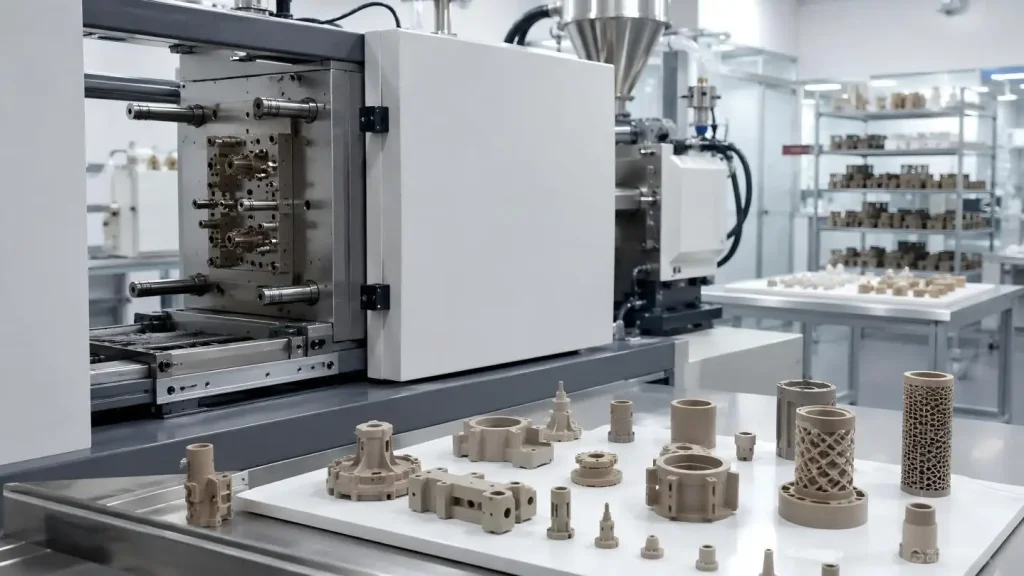
•CIM is selected when a component's geometry is complex and when the production volume is large.
•Feedstock preparation: Zirconia powder is mixed with organic binders, producing a feedstock that is more uniform and plastic in nature.
•Injection Molding: The feedstock is injected into a die under molding pressure.
•Debinding: The organic binders are removed to yield a "brown" part.
•CIM is useful for components that have complex internal geometries and thin walls and features. These designs would be very difficult to produce using traditional pressing techniques.
Additive Manufacturing
Technologies in development, such as binder jetting and freeform injection molding, greatly increase the potential engineering capabilities of zirconia ceramics. Advantages of these methods are:
•The ability to rapidly prototype without the need for any tools
•Manufacture components with much more complex designs
•Manufacture components with greater amounts of custom features for low volume, high value product lines
Step 3: Sintering – the Process of Achieving Full Density
Sintering is the process of making fully dense, solid ceramics by welding the particles together. This process is done by heating the shaped (green or brown) part to a high temperature.
Sintering temperatures for zirconia are from 1400 °C to 1520 °C. At these temperatures, zirconia particles are diffusion bonded, fully eliminating all porosity and achieving full density.
Zirconia sintering is a delicate balance. The rate of sintering, hold temperature, and cooling temperature, will all greatly affect the sintered part's final microstructure and mechanical properties. Sintering too fast will introduce cracking. Uneven heating will distort the part.
Advanced sintering technologies are being utilized:
•Two-step sintering enables grain growth to be separate from densification and yields microstructures with greater refinement.
•Sintering with RF induction utilizes the metal to insulator transition of zirconia above 1400 °C and reduces the time of conventional 8 hour sintering to 40 minutes.
•Flash sintering can achieve full densification in a matter of seconds at much lower temperatures.
Zirconia can be even more closely engineered. Sintering processes are controlled to achieve near 0% porosity, which allows zirconia to maintain a high level of stability during thermal shocks throughout a long operational life.
Step 4: Precision Machining
Precision machining may be necessary after sintering in order to meet the part tolerances.
Why sinter then machine? Zirconia shrinks 20-25% during sintering. While this shrinkage can be somewhat reliably controlled by altering the sintering cycle, sub-millimeter tolerances typically demand post-sintering machining.
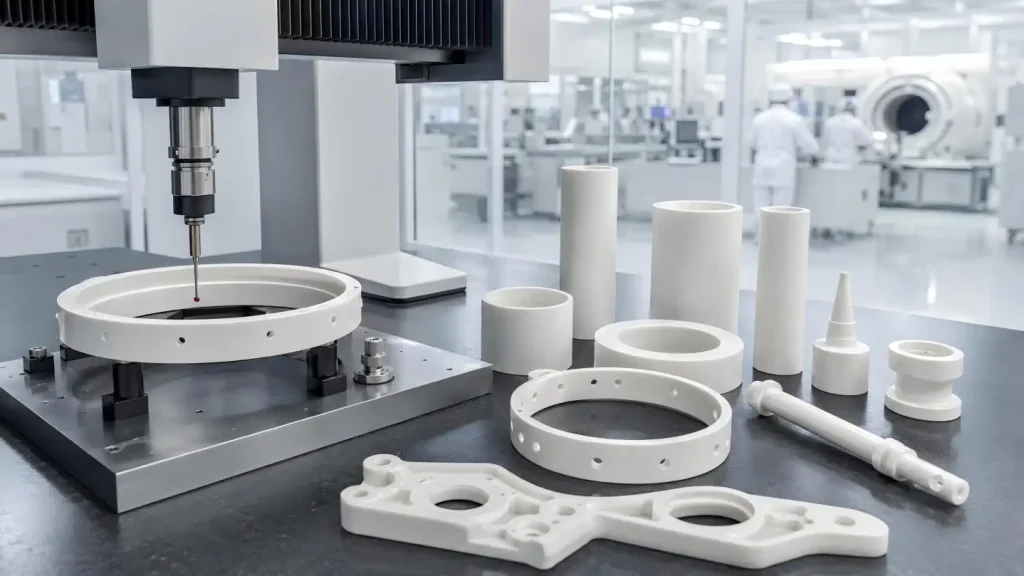
CNC machining is a good choice: CNC machining is the only viable method for processing sintered zirconia. It is performed with a high degree of precision with diamond tools. Diamond tools are the only tools that are viable for processing sintered zirconia.
Some of the other very relevant machining parameters include:
•Stepovers and feeds: Must be optimized for the threshold of the brittle fracture of the ceramic to avoid damaging the part by chipping.
•Coolant and thermal management: Preserves integrity and minimizes distortion.
•Adaptive Fixturing: Controls vibrations on fragile, thin-walled structures.
Precision is highly valued in this industry: Advanced manufacturers are achieving surface roughness between Ra0.02 to Ra0.2, roundness and concentricity tolerances of 0.002mm, and wall thicknesses of 0.1mm. This precision is critical in assembly of advanced products in electronics, optics, aerospace etc. due to the required quality of fit and the repeatability of the product.
Step 5: Quality Control and Inspection
The last step is intense inspection for meeting all component specifications.
•In-process metrology: Variation is monitored while tolerances are kept in the center during long production runs through closed-loop measurement.
•Statistical Process Control: A rigid system has been developed to manage the quality of every single lot. Gauges and optical measurements are used to check the critical dimensions.
•Environmental Control: In the case of semiconductors and medical devices, the capability of controlling contamination management is pivotal.
The UPCERA advantage: Full Chain Integration
Top manufacturers have the ability to perform every step, but particularly the capability to integrate the entire process chain.
Every step within the whole industry chain is controlled. Total vertical integration results in guaranteed quality of the product from powder to precision processed product.
•Manufacturing and materials control as one system: Manufacturers such as UPCERA have the ability to integrate system traits such as toughness, polishability, dielectric behavior and dimensional stability, all of which can be harmonized.
•Design assistance: Integrating the manufacturer early in the design concepts or prototypes aids in balancing and rationalizing designs, thickness, corner radius, and surface finish to protect the design's function and control costs.
•Guaranteed quality from a factory-direct source: Removal of intermediaries enables consistent quality at high volumes.
From Powder to Precision: The Total Process
The complete transformation of ZrO₂ ceramics from raw powder to precision structural components requires mastery and expertise for each step from powder engineering to final quality control, including shaping, sintering, and precision machining. Each step must be executed with the greatest care to realize zirconia's exceptional characteristics for the world's most demanding applications.
Whether designing aerospace parts that must survive extreme vibrations and temperatures; medical implants that must be biocompatible and durable; or semiconductor components that must have chemical cleanliness and dimensional stability; each of these examples will depend on whether manufacturing will allow the theoretical properties of zirconia to become practical.
For engineers and procurement specialists that need custom-made zirconia structural components, the best option is to engage with manufacturers that have total process control—from powder to high-precision finished products—and that have extensive experience and passion for the client in a critical application of this exceptional material.
For custom ZrO₂ structural ceramic components, we are the best choice and have the best combination of rapid response, short lead times, custom designs, custom materials, intricate designs and large geometries; all to the finest tolerances.
Frequently Asked Questions
Q 1: What is the usual manufacturing method for ZrO₂ ceramic structural components?
A: The usual method includes powder preparation, forming (pressing or injection molding), high temperature sintering, precision CNC machining, and final inspection.
Q 2: What is the typical yttria content for structural zirconia?
A: The most common grade is 3 mol% yttria‑stabilized tetragonal zirconia (3Y‑TZP), which presents the ideal combination of strength, toughness, and wear resistance.
Q 3: What is the best precision that can be achieved on zirconia components?
A: Roundness and concentricity of 0.002 mm, surface roughness of Ra0.02 to Ra0.2, and wall thickness of 0.1 mm are tolerances that can be achieved by UPCERA.
Q 4: Can zirconia parts be made that contain complex internal features?
A: Yes, ceramic injection molding (CIM) can produce complex shapes with internal structures that are thin and difficult or impossible to produce with traditional pressing.
Q 5: What makes sintering so important to the performance of zirconia?
A: Sintering transforms a powder body into a near‑fully dense body and a good control of the temperature during the process will allow the control of the final grain size, porosity and of the mechanical properties of the body.


In This Article
- 1 Step 1: Choosing and Processing High Purity Ceramics Powders
- 2 Step 2: Forming and Shaping
- 3 Step 3: Sintering – the Process of Achieving Full Density
- 4 Step 4: Precision Machining
- 5 Step 5: Quality Control and Inspection
- 6 The UPCERA advantage: Full Chain Integration
- 7 From Powder to Precision: The Total Process
