 English
 中文
中文







Ruby Nozzle and Its Diverse Industrial Applications
Related Posts
Study on the Material Properties, Manufacturing Process, and Industrial Applications of High-Precision Zirconia Ceramic Sleeves
July 16, 2026
UPCERA's Process-Led Ceramic Machining Service For Coordinated Material Applications
April 15, 2026
How to Pick the Right Machined Ceramic Components
August 22, 2025
Most manufacturing business relies on components that affect efficiency, accuracy, and strength. The Ruby Nozzle is an example of a critical component. Ruby Nozzles are made with single crystal sapphire and single crystal Alumina, also known as aluminum oxide (Al₂O₃). Manufacturing processes that are the most difficult and most demanding use Ruby Nozzles.
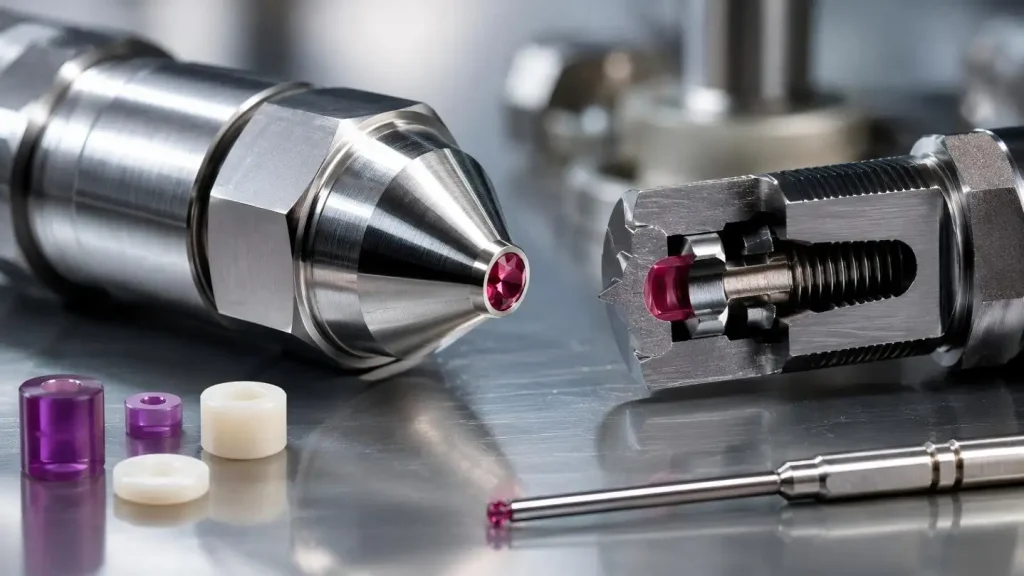
One of the major features of the Ruby Nozzle is its resistance to wear, stability to high temperatures, and being inert to corrosion and abrasion, which are impossible to achieve by the metal nozzles. The purpose of this article is to describe the different processes in which Ruby Nozzles are used and how Ruby Nozzles are made by manufacturing companies like UPCERA.
What Makes a Ruby Nozzle Special?
In order to appreciate the different processes in which a Ruby Nozzle is used, some concepts related to material science need to be understood. Ruby is the name given to the red color of Briband and, together with colorless sapphire, are both of the trifling crystals, corundum. Because they are so similar, they can be used in the same applications with the same mechanical requirements.
Some of the critical characteristics of Ruby Nozzles are:
•Exceptional hardness (Mohs 9): Outlasts all metals and other materials which are commonly used to make orifices.
•High-temperature tolerance: Melting point at 2050 °C, suitable for extreme thermal environments.
•Superior corrosion resistance: Almost chemically inert, and so maintains its integrity to highly aggressive fluids.
•Zero porosity: Ensures highly repeatable flow rates and prevents fluid contamination.
•High surface finish capability: Accepts optical-grade polishing for frictionless performance.
Industrial Applications of Ruby Nozzles
1. Papermaking: Precision Cleaning and Edge Trimming
High-pressure Ruby Nozzles have been used in papermaking for quite some time now. Ruby nozzle technology is used in modern paper machines for HP showering to clean and condition forming fabrics as well as press, dryer, and roll felts. The needle jet ruby-tipped jet stream nozzles are used to deliver precise, columnar, high-pressure fluid streams.
Here are some benefits of using this technology in papermaking:
•Optimum washing. This is the best cleaning achieved by ruby-stopped nozzles because of the high-impact concentrated fluid stream. As a result, the filtration of water through the fabric and felt is enhanced, as well as the working life of the fabric and felt.
•Exact edge trimming. The ruby orifice trim nozzles provide highly concentrated, solid round streams of fluid that cut the wet paper to the desired width.
•Cost-effective. The optimal results are achieved with the least quantity of water.
•Durability. Ruby is more durable than other materials in the abrasive environment of the papermaking industry.
All of these characteristics combined have led companies such as ANDRITZ to regard ruby-insert nozzles as the latest and greatest technology for most pulp and paper machines. These nozzles guarantee the best jet technology available and an excellent service life.
2. Waterjet Cutting: Speed and Precision
Advantages in waterjet cutting technology may be offered by Ruby Nozzles. Nozzles are used to create jets measuring 0.08 to 0.4 mm in diameter, which can be produced with high precision using ruby ring jewels. These jets can exit a nozzle at super sonic speeds, with pressures reaching 4,000 bar, and are considered to be one of the most powerful jets in the industry.
There are three main cutting modes which are facilitated by Ruby Nozzles:
•Pure water cutting: This is used to cut soft materials such as insulation, rubber, sealing materials, and even paper.
•Abrasive cutting: This cutting technique adds garnet sand, which enables jets powerful enough to cut steel, glass, natural stone, plastics and many other materials.
•Micro cutting: This is a technique used to cut extremely small parts (microscale) from hard to cut materials (engineering steels, brass, chromium, titanium) and requires orifices to be as small as 0.05 mm.
Waterjet cutting, using Ruby Nozzles, has one of the most important advantages over thermal cutting, which is that no heat is transferred to the workpiece. The material structure is completely changed with waterjet cutting.
3. Coil Winding: Protecting Delicate Enameled Wire
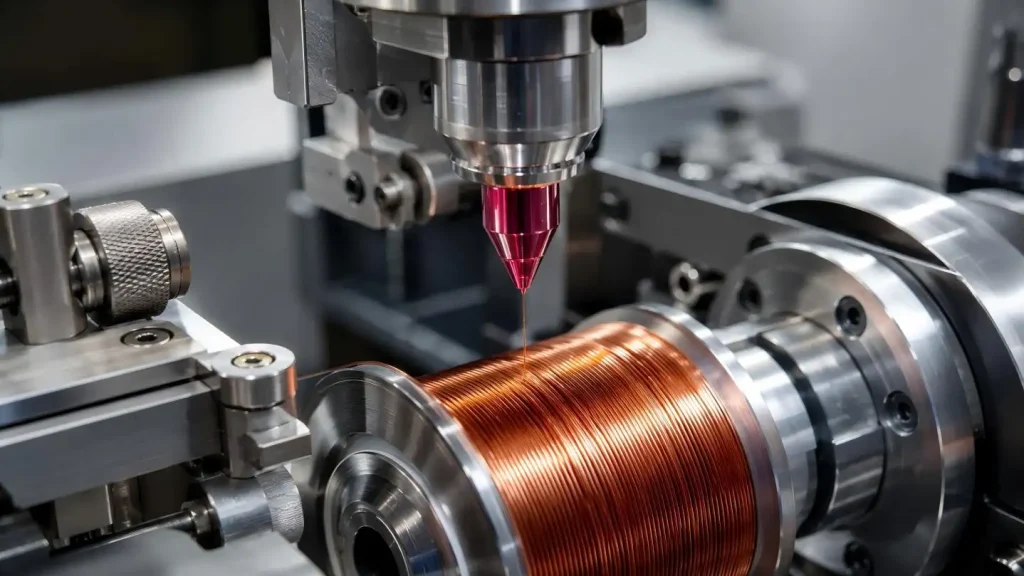
In the power and electronics industry, Ruby Nozzles are integral to CNC automatic winding machines. These Nozzles incorporate ultra-smooth, mirror-polished ruby. This drastically reduces the friction and risk of damaging the insulating varnish on ultra-fine enameled wires.
Applications include:
•Consumer electronics and power inductors
•High-precision medical devices
•Automated winding systems for fine and thin coils
Ruby Nozzles are made of single-crystal ruby, which contains a high level of cleanliness and brightness, and provide a high level of performance, even after millions of cycles.
4. Medical and Life Sciences
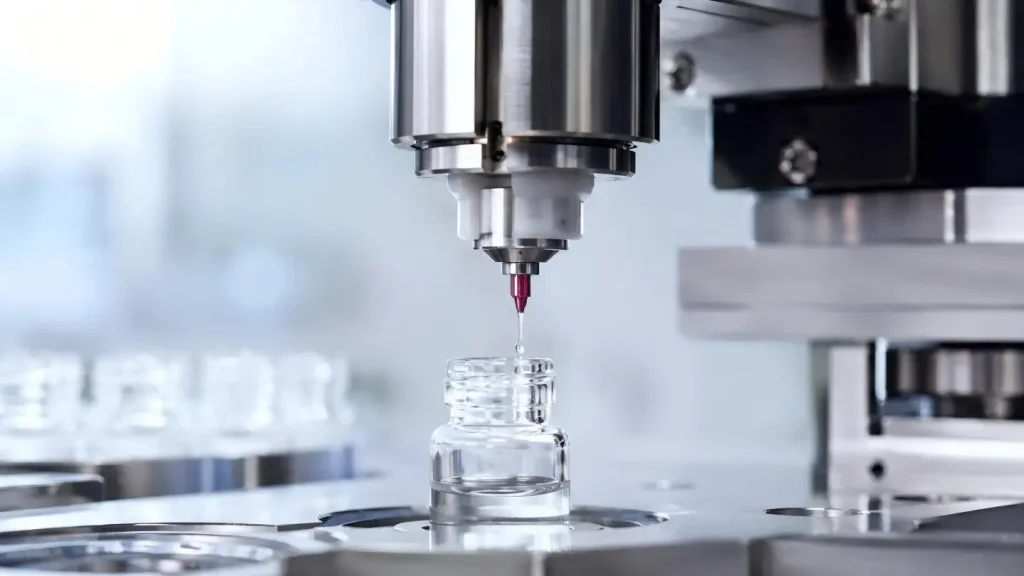
There is no room for error in medicine. Blood-seeping and fluid dispensing devices, among others, contain Ruby Nozzles. Ruby Nozzles are permeable and chemically inert. Thus, they're excellent for applications requiring sterile fluids.
Ruby Nozzles see some use in medicine for the following:
•Fast and/or accurate dispensing of fluids with jets that are stable and/or accurate
•Devices for therapeutic and diagnostic lasers
•Optical endoscopic devices that are abrasion resistant
5. Semiconductor and Electronics Manufacturing
Semiconductor manufacturing is one of the industries that demand the toughest requirements from the products it uses. In this industry, Ruby Nozzles are used in wafer cleaning, plasma-resistant tubes, and insulator parts.
Some of the best qualities Ruby Nozzles have in semiconductor processing are:
•Exceptional hydrophobic characteristics that promote better fluid flow and no material build up
•Better flow with smaller orifice dimensions, made possible by ruby's ability to accept higher surface finishes and tolerances compared to metal
•Much better lifespan in abrasive environments that are common in wafer processing
6. Aerospace and Defense
Ruby Nozzles are utilized in high-speed, high-pressure optical systems and infrared domes. They provide excellent optical transmission in the 0.20–5.50 μm wavelengths. The material's thermal stability keeps the infrared transmission unaffected by temperature shifts.
Some aerospace disciplines are:
•Military night vision and infrared systems.
•Cryogenic laboratory observation ports.
•High precision navigation systems for aerospace and aviation.
7. Textile and Fiber Processing
The textile industry also employs Ruby Nozzles for processing synthetic fibers, dyeing, and precision measurement systems. Extreme wear from fiber does not affect the consistent operation of the nozzles.
UPCERA: Engineering Excellence in Ruby and Sapphire Components
UPCERA is the driving force for many of these applications. With more than 20 years of experience in the field, they are considered one of the leading experts on the full process of designing and manufacturing components. Their offers include custom components made from precision ceramics based on ruby, sapphire, zirconia, alumina, and nitride of silicon and aluminum, as well as silicon carbide.
Why Work with UPCERA?
•Direct supply from factory: Premium quality and cost effectiveness
•Custom production: Based on application needs
•Full industry chain: Industry chain from powder to precision machining and post-processing assurance
•Matchless tolerances: Precision of ±1 micron
•Surface finishing: Optical polish (5Å RMS), frosted, matte finish, and laser marking for traceability
•Quality assurance: Interferometry, profilometry, and dimensional analysis for every batch
•With more than 178 product patents and a 26,000-square meter modern R&D and production base, UPCERA supplies more than 100 countries.
Why Ruby Nozzles Will Dominate the Industrial Sector
The continued evolution of Industry 4.0 will naturally create a demand for reliable, precise components with endurance to meet the challenges posed by extreme conditions. Ruby Nozzles possess the hardness, thermal stability, and chemical resistance to satisfy the requirements.
Whether you require:
•High-performance optical windows
•Wear-resistant ruby orifices
•Custom sapphire assemblies
•Precision fluidics components
UPCERA delivers not just parts—but performance, consistency, and customization that elevate your product's capabilities.
From the paper machines that produce the world's packaging to the waterjets that cut aerospace components, from the winding machines that build our electronics to the medical devices that save lives—the Ruby Nozzle works silently, reliably, and indispensably. It is, truly, the unsung hero of Industry 4.0.
Contact UPCERA today to discuss your application, request a quote, or collaborate on a custom component.
FAQ
Q: What material is a Ruby Nozzle made from?
A: They are constructed from single crystals of aluminum oxide (Al₂O₃), which is the same extremely hard material as natural rubies and sapphires.
Q: What are the advantages of a Ruby Nozzle over a standard metal nozzle?
A: Rubies have a Mohs hardness of 9, and because of their exceptional wear resistance and chemical inertness, service life is extended in erosive and corrosive environments by 10 to 20 times.
Q: What are the common applications of Ruby Nozzles?
A: Ruby Nozzles are essentially used in the papermaking, waterjet cutting, coil winders, medical devices, semiconductor processing, aerospace, and textile manufacturing industries.
Q: Are Ruby Nozzles designed for specific applications?
A: Ruby Nozzles are completely custom designed by manufacturers such as UPCERA for the specific size, shape, tolerance (to ±1 micron), and surface finish.
Q: What is the maximum pressure that a Ruby Nozzle can handle?
A: During waterjet cutting, ruby orifices are capable of withstanding pressures of up to 4,000 bar (≈58,000 psi) and still maintain the geometry of the jet.


In This Article
- 1 What Makes a Ruby Nozzle Special?
-
2
Industrial Applications of Ruby Nozzles
- 2.1 1. Papermaking: Precision Cleaning and Edge Trimming
- 2.2 2. Waterjet Cutting: Speed and Precision
- 2.3 3. Coil Winding: Protecting Delicate Enameled Wire
- 2.4 4. Medical and Life Sciences
- 2.5 5. Semiconductor and Electronics Manufacturing
- 2.6 6. Aerospace and Defense
- 2.7 7. Textile and Fiber Processing
- 3 UPCERA: Engineering Excellence in Ruby and Sapphire Components
- 4 Why Ruby Nozzles Will Dominate the Industrial Sector
Related Posts
Study on the Material Properties, Manufacturing Process, and Industrial Applications of High-Precision Zirconia Ceramic Sleeves
July 16, 2026
UPCERA's Process-Led Ceramic Machining Service For Coordinated Material Applications
April 15, 2026
How to Pick the Right Machined Ceramic Components
August 22, 2025
