 English
 中文
中文







Custom Alumina Ceramic Components: A Practical Design and Sourcing Guide
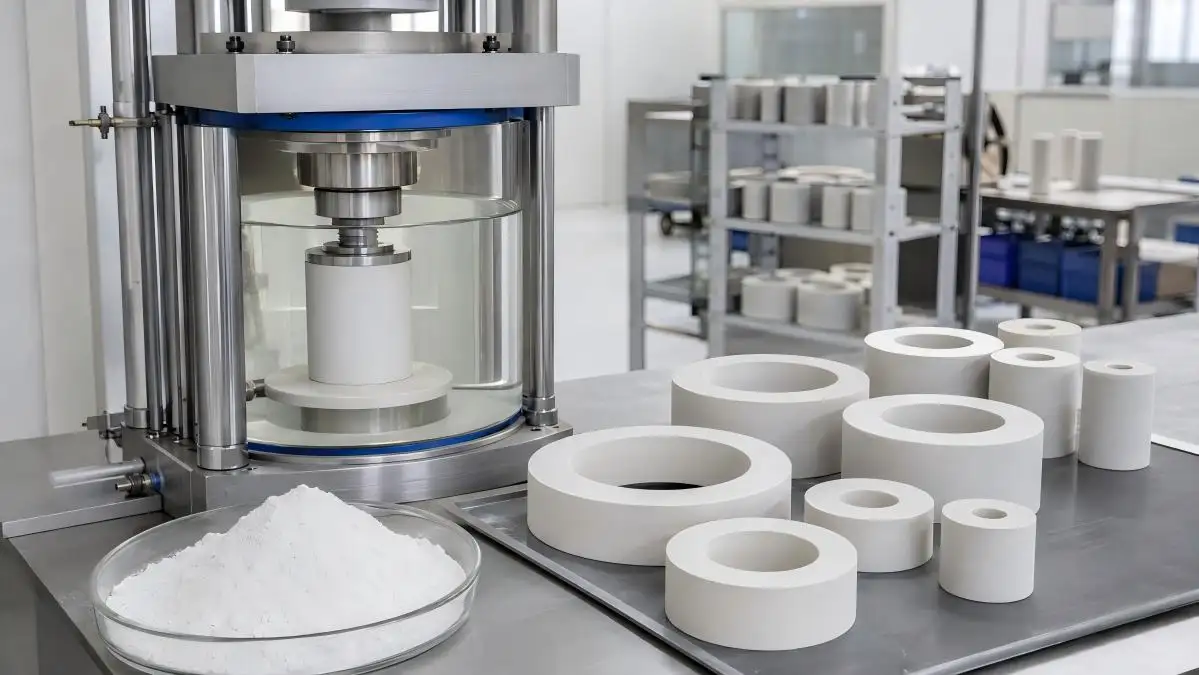
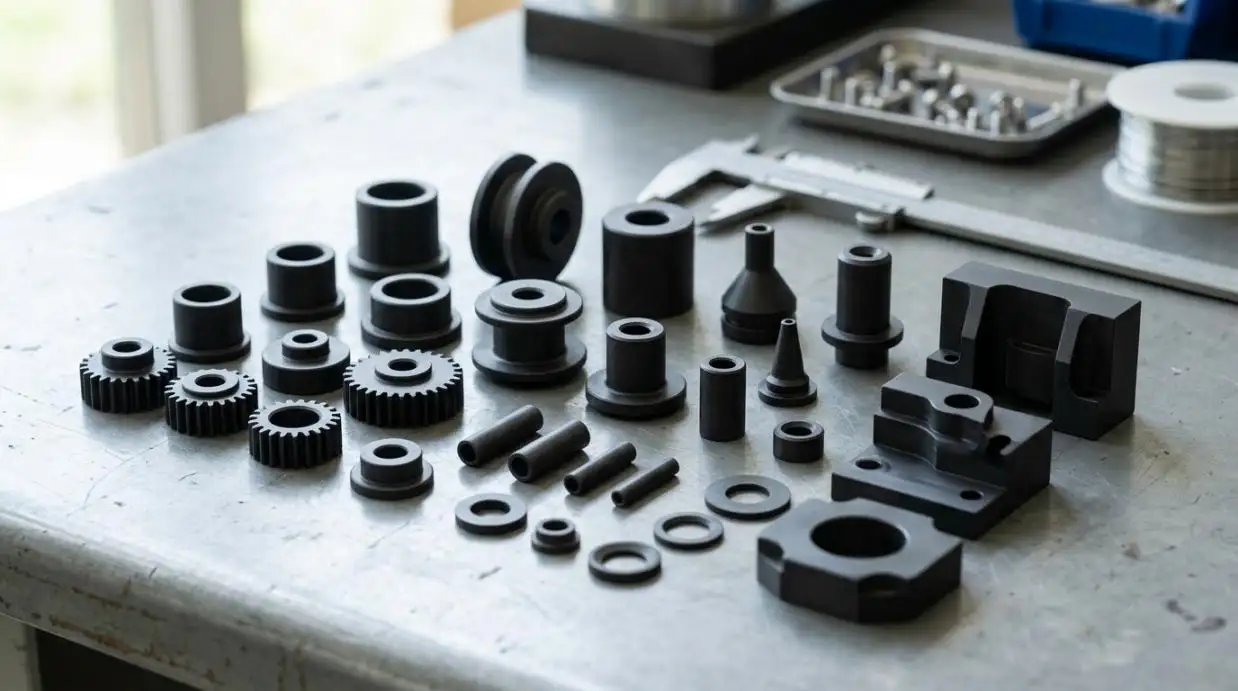

Alumina, which has electrical insulation properties, is one of the most popular technical ceramic materials together with its hardness, chemical stability and high temperature properties. Can be used to replace metals or polymers in elements that are subjected to voltage, abrasion, heat or corrosive media.
But, to make a successful custom alumina ceramic part isn’t just a matter of converting a metal drawing into ceramic. The purity should be combined with forming method, sintering shrinkage, machining access, edge design and inspection requirements to be considered. An early engineering decision will dictate whether the part will be reliable and cost effective to produce.
Custom Alumina Components are most valuable in certain applications.
Alumina is particularly valuable where a number of performance criteria are combined. A component might require electrical isolation of an assembly and shape maintenance under heat or need resistance to the abrasive movement without introducing metallic contamination.
Some of the common custom components are:
- Electrical insulators and spacers
- Plungers, valve seats and nozzles for pumps.
- The use of wear plates, bushings and guide parts.
- Handling and positioning components for semiconductors
- Housing and feedthroughs for sensors
- Fixtures and supports that will be subjected to high temperatures.
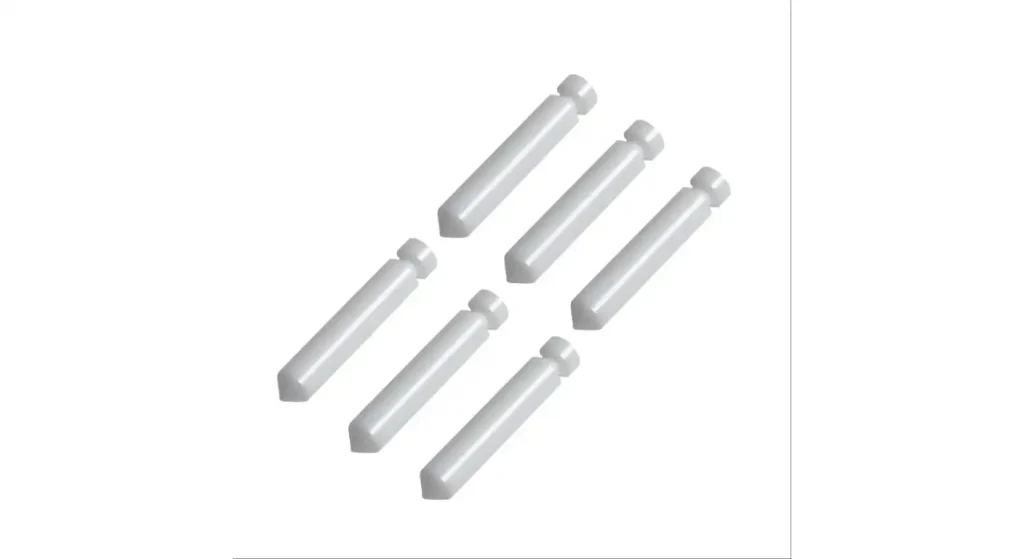
- Ceramic shafts, ceramic rods and ceramic locating pins
Engineers can visit UPCERA’s custom ceramic structural components to see various shapes utilized in machinery, electronics, semiconductor equipment and fluid-control systems.
Choose the appropriate Alumina Purity for the Application
If a component’s purity is higher, it isn’t necessarily better. The proper grade will vary based on the conditions, electrical needs, finishing and cost of the project.
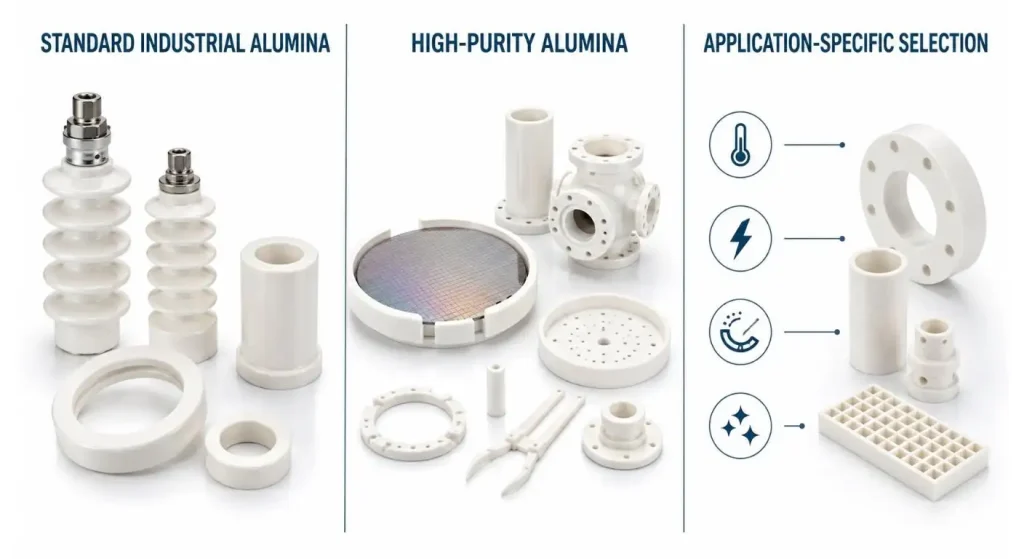
The standard industrial alumina grades provide a good balance of hardness, insulation and production efficiency. They are frequently suitable to be used as wear parts, general insulators and structural supports. Grade with higher purity may be desired for vacuum applications, semiconductor equipment, critical electrical applications or where contamination must be kept to a minimum.
The UPCERA material overview on alumina offers more details about the common types of alumina and their characteristics in industry.
Prior to choosing a grade, specify:
- The continuous operating temperature, and peak operating temperature.
- Required dielectric performance
- Mechanical loads, including impact and bending conditions
- Exposure to chemical or plasma.
- Acceptable surface finish
- Limits of cleanliness and contamination.
- The required product life and the desired product cost.
The final selection should take into account functional performance in addition to the feasibility of forming, sintering and machining.
Adapt Component Geometry for Ceramic Manufacturing
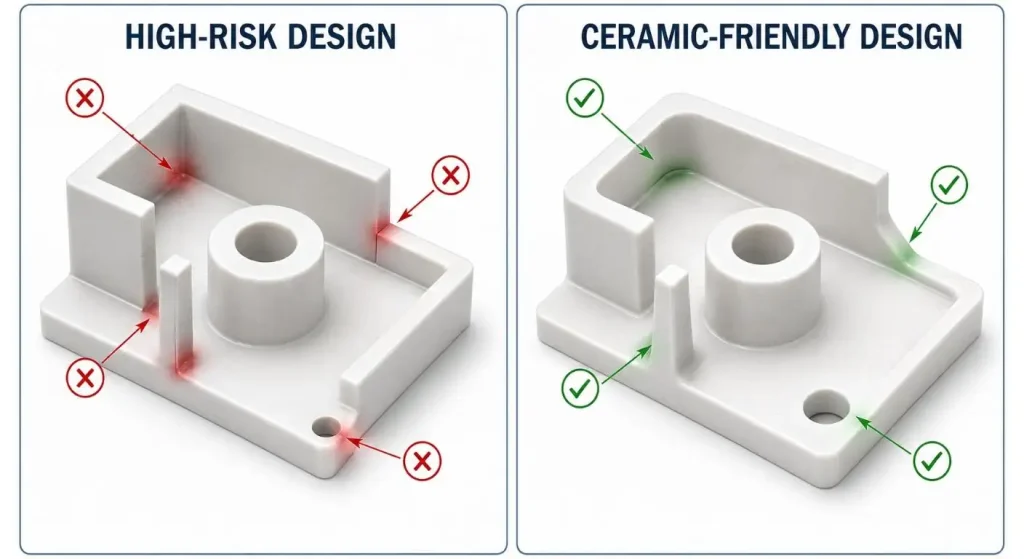
Alumina has good compression resistance, and is less impact resistant and less tolerant of tensile stress and stress concentrations than metal. Unsupported thin sections, changes in wall thickness and sharp corners can be fracture points.
| Design Feature | Recommended Approach | Manufacturing Benefit |
| Internal corners | Add practical radii | Reduces grinding difficulty and stress |
| External edges | Use chamfers or rounded edges | Limits chipping during handling |
| Wall sections | Keep thickness reasonably uniform | Improves shrinkage consistency |
| Precision dimensions | Restrict to functional interfaces | Reduces final machining cost |
| Holes | Maintain sufficient edge distance | Lowers cracking risk |
| Metal contact | Distribute the clamping load | Prevents localized ceramic stress |
| Assembly clearance | Consider thermal expansion | Improves thermal-cycle reliability |
Where possible external corners should be chamfered or rounded. Practical internal corners are required as it is not possible to obtain a clean internal corner with a precision grinding tool. Holes too close to an edge may cause chipping during machining or cracking during assembly and service.
In addition, uniform wall thickness enables to control the sintering shrinkage. Where a thick section is required to connect with a thin wall, then a gradual transition is better. It is important that the engineer does not specify tight tolerances on all surfaces; precision finishing is only usually required on surfaces that are interfaces and have a controlling effect on assembly, sealing, alignment or movement.
Match the Manufacturing Route to Geometry and Volume
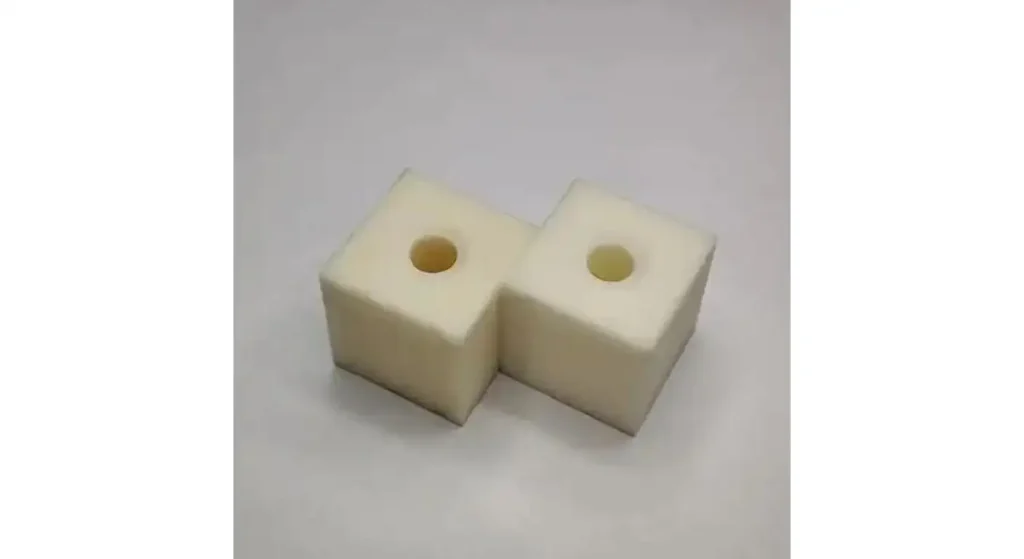
Alumina parts can be made in custom-made shapes by pressing, extrusion, ceramic injection molding or other forming processes. Depending on the shape complexity, the size of the components, the tolerance and quantity, the best route would be indicated.
Parts that are simple cylindrical or flat shapes could be pressed, and long rod or tubes could be extruded. If you need to make a lot of parts, it is possible to make smaller and more complex shapes using Ceramic Injection Molding.
Once formed, the green body is debound and then sintered. Shrinkage occurs during sintering and must be considered in tooling and process design.Shrinkage will occur during firing, so that the supplier must take this into account for tool and process set-up. Diamond grinding, lapping, drilling or polishing then takes place to produce critical dimensions.
According to UPCERA’s advanced ceramic machining guide, one reason why ceramics need to be machined with material-specific tooling is because it’s necessary to have controlled delivery of a coolant and stable fixturing.
Explain Tolerances around Function
One of the most prevalent reasons of needless ceramic-part expense is over-tolerancing. Post-sintering machining is more expensive and slower than the traditional metal cutting processes particularly where multiple surfaces are involved with strict geometric relations.
Identify the dimensions that have a direct control on:
- Including a fit with mating components.
- Electrical clearance
- Sealing performance
- Concentric rotation
- Fluid flow
- Positioning accuracy
- Surface contact
Wider tolerances can be used on non-functional surfaces in the majority of cases as either as-fired or as-sintered. It is also important that a drawing differentiate dimensional tolerance from surface roughness, flatness, roundness and concentricity. Different methods of finishing and inspection may be required for each requirement.
Plan the Assembly to Minimize Ceramic Stress
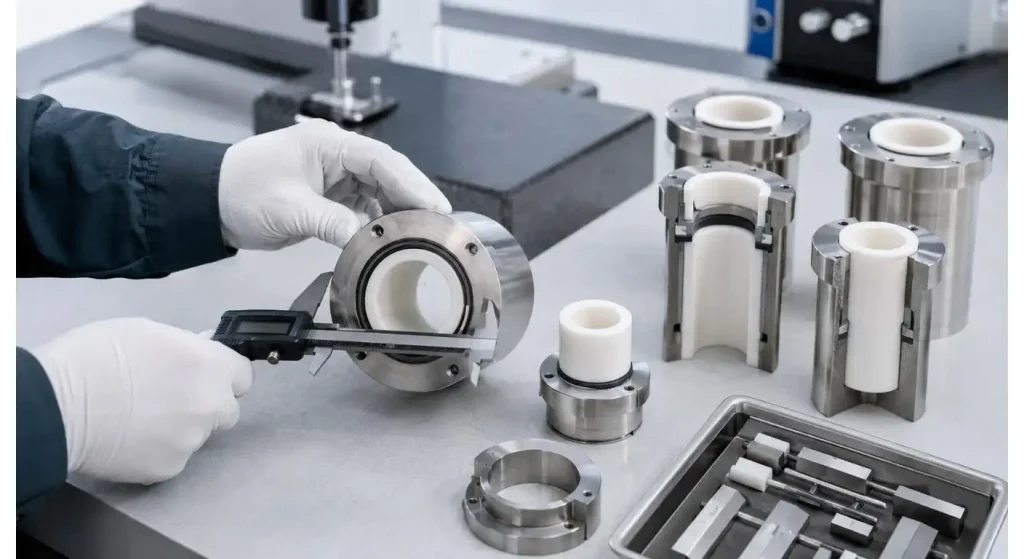
Forcing ceramic parts into metal components without considering thermal expansion and contact stress can lead to cracking.Interference fit, metal fastener & clamping loads can cause the ceramic to crack during installation or during thermal cycling.
Wherever practicable, employ controlled clearances, compliant washers, bonding or ceramic-metal assembly methods evaluated according to project requirements.Loads need to be evenly distributed across surfaces of contact and fastener torque should be defined.
Testing of a prototype should be done within the actual assembly and not just as a single ceramic component.
Create an RFQ to Aid in Accurate Evaluation
A good Request for Quotation should contain 2D drawings, if they have 3D files available, alumina purity, application conditions, critical tolerances and surface requirements and an estimated quantity.
Also determine if it is for a prototype, a pilot batch or a recurring production. If an existing part (metal or plastic) is failing, describe the failure mode and if possible, show a sample of it.
Customers can contact UPCERA for a manufacturability review with their drawings, application environment, quantity and inspection requirements.
Conclusion
Custom alumina ceramic components offer a high insulation, wear-resistant and chemically stable and high-temperature reliable combination. Only with a right choice of purity and geometry adapted to the behavior of ceramics, can they be successful, and only precision be applied where it adds functional value.
The designer working closely with the ceramic manufacturer in the early stages of design can minimise the risk of cracking and the cost and delays involved in machining and improve long term consistency of the ceramic components.
FAQ
Q1. Will alumina ceramic parts be made from my design?
Yes. The manufacturer will verify the material, geometry, tolerances, surface finish and number of parts prior to determining the process and quoting.
Q2. Which alumina purity should I go for?
It is dependent on the electrical, thermal, mechanical and cleanliness requirements. It may be the case that general industrial parts do not need the highest-purity (and the highest-cost) grade.
Q3. Is it possible to make threads and holes in alumina ceramic parts?
Yes, but the minimum feature size, depth and wall thickness and tolerances must be considered. Holes and threads may be formed before sintering or precision-machined after sintering, depending on geometry, tolerance and material requirements.
Q4. Can Alumina be used for parts that are impacted?
Alumina is hard, wear resistant and relatively brittle. If impact or bending loads are the primary consideration, then zirconia or some other more impact-resistant ceramic might be more appropriate.
Q5. Are prototypes made prior to mass production?
Yes. Prototypes are used to validate dimension, assembly, surface and operating performance prior to production tooling or larger quantities being approved.


In This Article
- 1 Custom Alumina Components are most valuable in certain applications.
- 2 Choose the appropriate Alumina Purity for the Application
- 3 Adapt Component Geometry for Ceramic Manufacturing
- 4 Match the Manufacturing Route to Geometry and Volume
- 5 Explain Tolerances around Function
- 6 Plan the Assembly to Minimize Ceramic Stress
- 7 Create an RFQ to Aid in Accurate Evaluation
- 8 Conclusion
