 English
 中文
中文







Zirconia Tubes in Semiconductor Manufacturing: Precision Ceramics for Chip Production
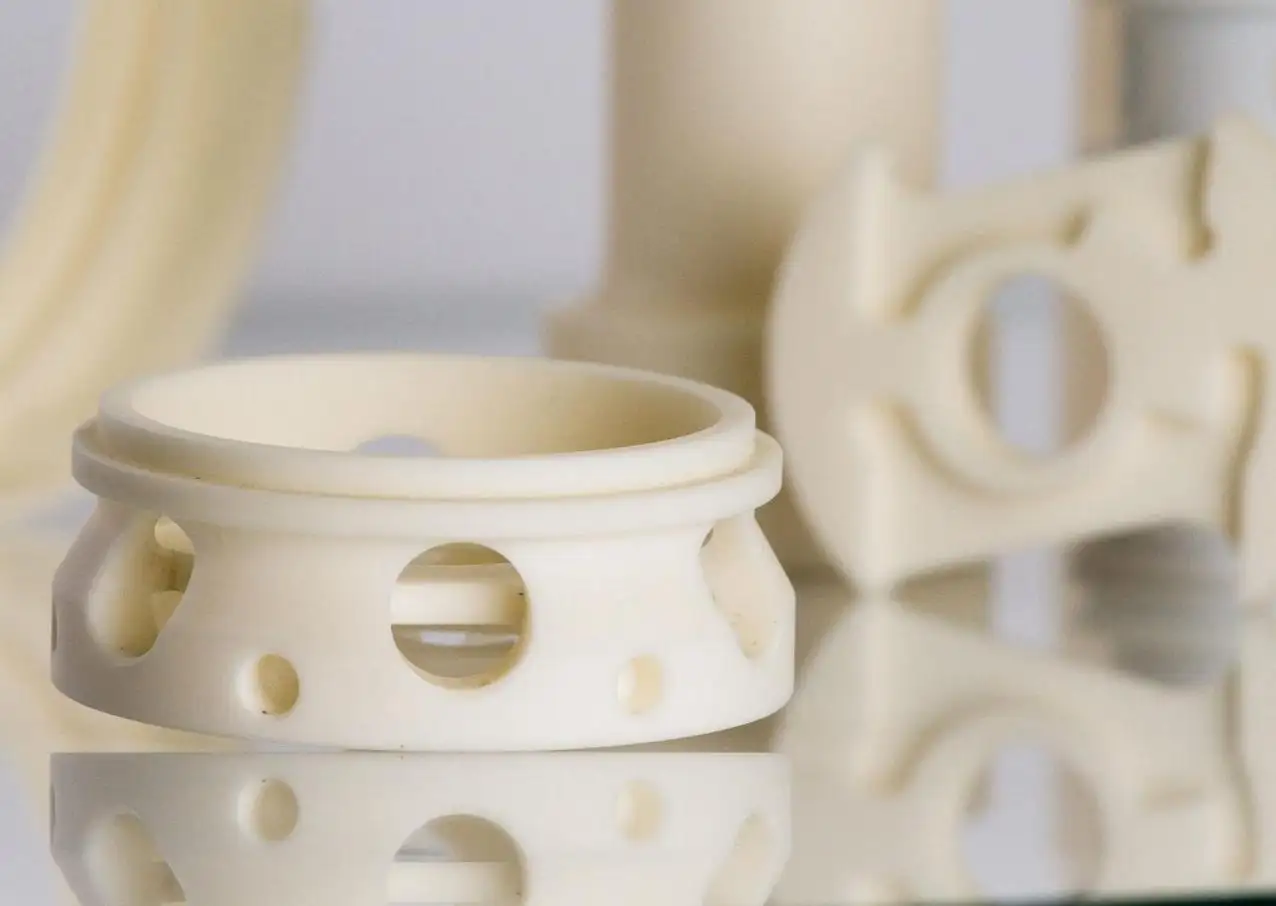
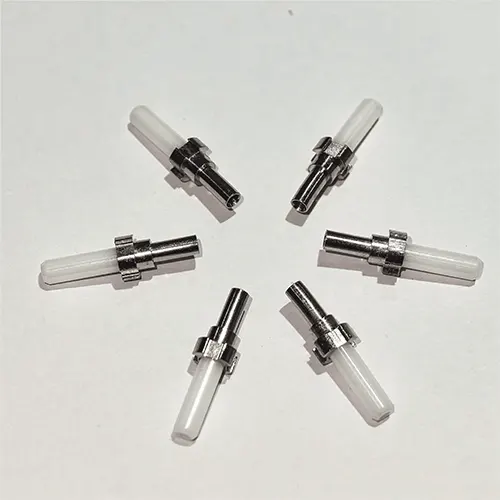
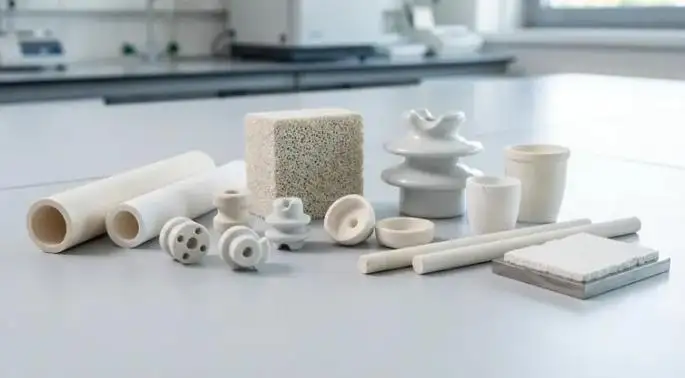
Semiconductor manufacturing takes an extreme toll on materials. Silica wafers and photo lithography tools receive the most public interest, but Zirconia Tubes (ZrO₂) are equally important. Zirconia Tubes are one of the most ubiquitous tools in fabrication. This article examines what Zirconia Tubes are, the properties that make them essential in fabrication, and what UPCERA has to offer.
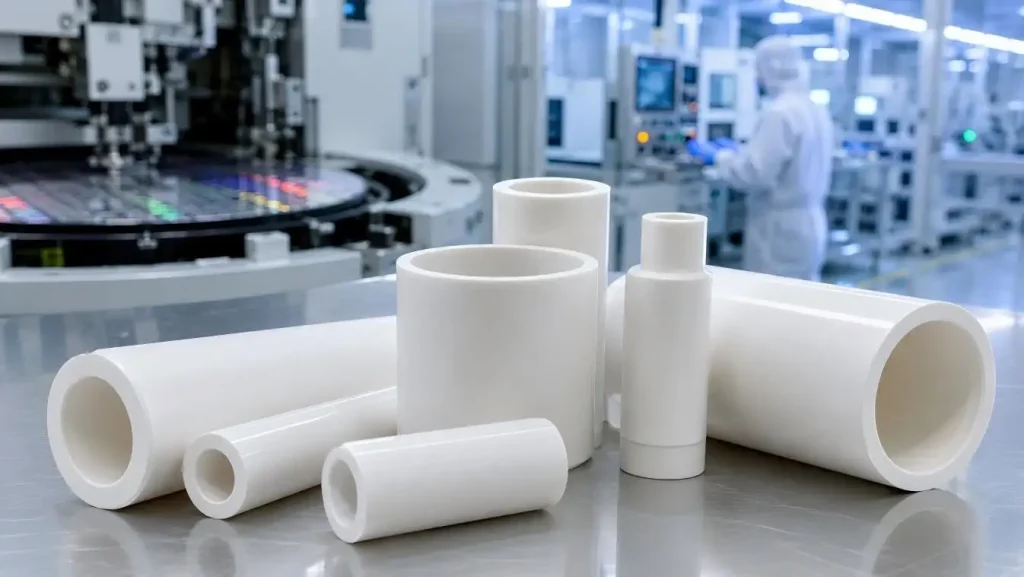
What is a Zirconia Tube?
Zirconia tubes are a high-performance technical ceramic that are tough, durable, and measure the highest level of ceramic toughness because of a transformation toughening process that is sustained by Yttria (Y-TZP). This toughening gives Y-TZP zirconia superior toughness to other traditional ceramics like alumina.
Some other advantages of high-performance Zirconia Tubes are:
•Strength: Flexural strength exceeding 1200 MPa which is greater than most engineering metals.
•Density: High density (>6.0 g/ cm³) with ultra-low porosity
•Porosity: Extreme hardness (≥9 on Mohs scale) with superior wear resistance of Zirconia Tubes
•Chemical Resistance: Resistance to acids, alkalis and aggressive process chemicals
•Electrical Insulation: Excellent electrical insulators (with a volume resistivity of > 1×10¹¹ ohm·cm at room temperature).
•Thermal Stability: Zirconia Tubes possess insensitivity to dimensional changes that would normally occur due to repeated thermal cycling.
In contexts such as the manufacturing of semiconductors, Zirconia Tubes bring solutions to problems encountered where metals and polymers are involved.
Why Zirconia Tubes are Important to Semiconductor Manufacturing
1. Supply Tubes for Ultra-Pure Process Gases
Manufacturing semiconductors requires the use of totally pure process gases (for example silane and various dopants) that must be brought to the reaction chambers without any sort of contamination. Zirconia Tubes can be used for supply tubes to transport these gases because of the following:
•Chemical Inertia: Zirconia Tubes will not react with the process gases, even if they are highly corrosive, and as a result will not cause contamination to the process gases.
•Chemical Porosity: The dense structure of a Zirconia Tube means that there is no gas absorption or out-gassing.
•Surface Finish: The highly dense and closed surface of Zirconia Tubes is easy to clean and minimizes particulate retention.
2. High-Temperature Furnace Components
Most semiconductor processes, such as, diffusion, oxidation, and annealing, are carried out at temperatures above 1000°C. Zirconia Tubes can be used as:
•Sleeves for thermocouple protection: These tubes can be used as protection for thermocouples from contact with highly corrosive and/or molten materials.
•Support tubes and liners: These tubes can be used for supports of heating elements at temperatures above the softening and/or deforming points of some metals.
•Thermally efficient, highly effective, and low thermal loss tubes: Zirconia tubes have a thermal conductivity of less than 3 W/m·k.
3. Etching and Deposition Equipment
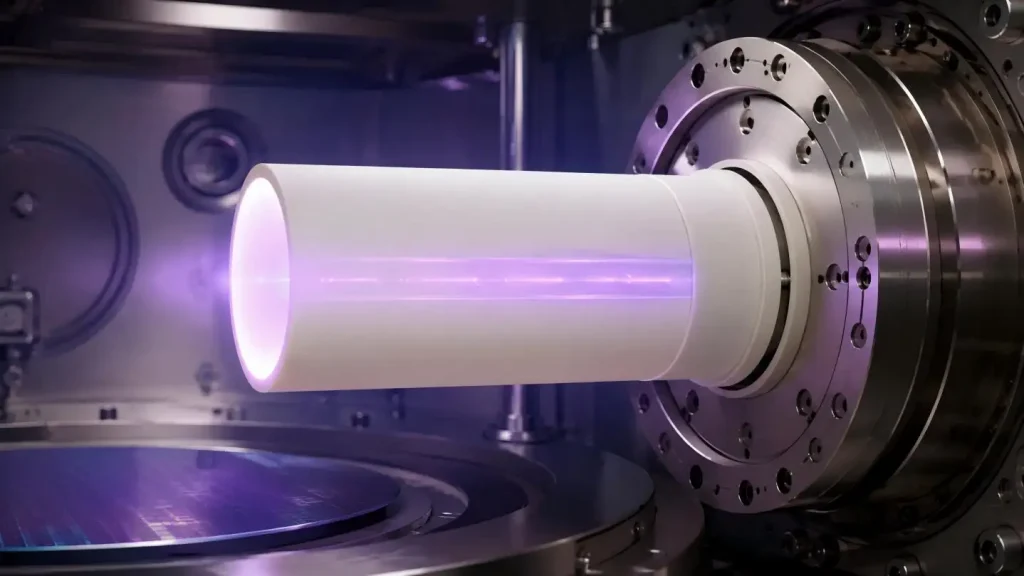
For processes that involve etching, CVD (Chemical Vapor Deposition) and PVD (Physical Vapor Deposition), High-Temperature Zirconia Tubes are used which are subjected to both corrosive plasmas and elevated temperatures. Zirconia Tubes are:
•Plasma resistant: The tubes are resistant to physical and chemical erosion in an ion etching process.
•Stable in dimension: The tubes maintain their inner and outer diameters and tolerances after being subjected to thousands of process cycles.
•Contamination free: Zirconia Tubes do not release metallic contaminants which are detrimental to silicon wafers.
4. Wafer Handling and Protection
Zirconia tubes provide:
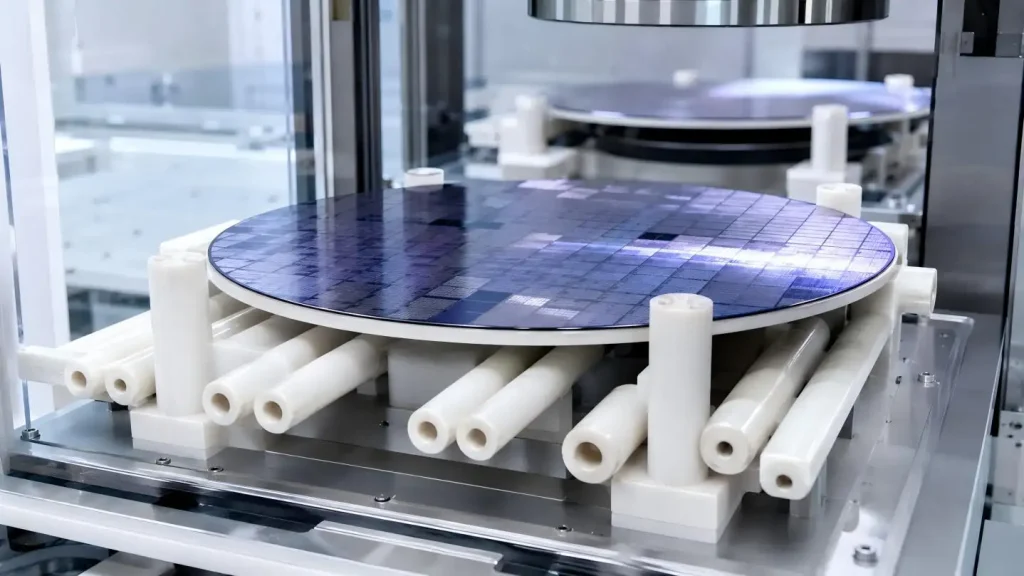
•Wafer Protection: Give consideration to the support needed for fragile wafers during high temperature processing.al Isolation: Protection of electronic structures from ESD.
•Cleanroom Safety: Non-porous tubes that do not create particulates.
UPCERA: Two Decades of Precision Ceramics
Established in 2003, UPCERA is China's first developer and manufacturer of zirconia ceramic sleeves for fiber optics, following 20 years of development of precision ceramics.
1. Zirconia Tube Manufacturing
Zirconia Tube manufacturing includes:
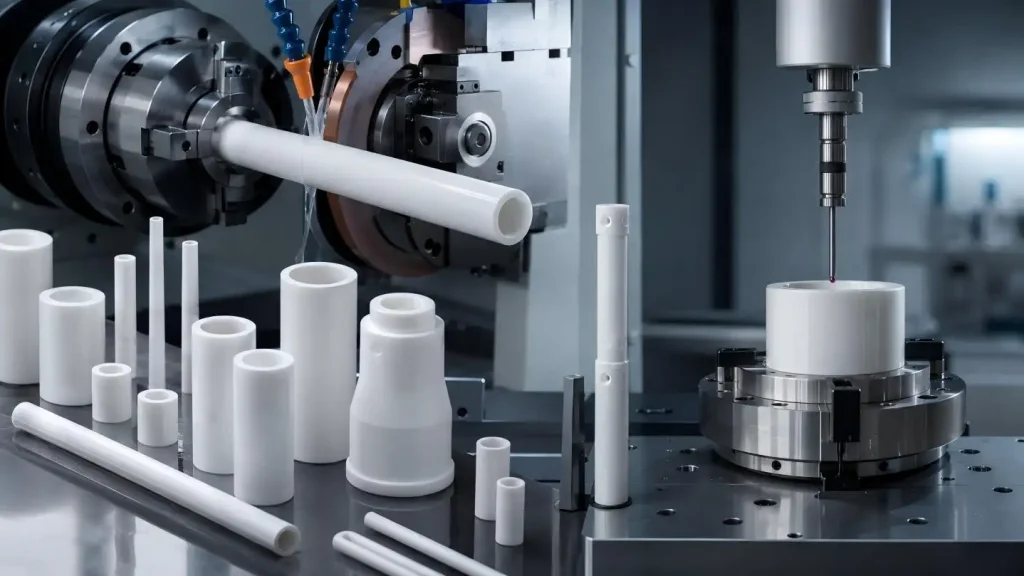
•Tubes are Sintered at high-temperatures of 1500-1800 °C.
•Post Sintering, CNC Machining is done to a tolerance of ±0.005mm.
•Capability to Produce Various Materials: YSZ, ATZ, ZTA, blue and black zirconia, and other special formulations.
Precision Assurance:
•Uprecare Zirconia Tubes are designed for use in the semiconductor industry.
2. Zircon Tubes and Precision Assurance
•Tubes with outer diameters 1-25 mm shall have an outer diameter of ±0.002 mm; and tubes with outer diameters of 20-50 mm shall have an outer diameter of ±0.003 mm.
•For tubes of diameters 0.5-3 mm, the precision of the inner diameter shall be ±0.001 mm, and of 3-10 mm, shall be ±0.003 mm.
•Tubes are made with Lengths of up to 1000 mm, with a precision of ±0.005 mm.
•Surface Roughness of Ra0.03.
•Roundness, Concentricity and Straightness of ±0.002 mm, ±0.002 mm, and ±0.004 mm, respectively.
3. Dimensional Range
Zirconia tubes are available in the ranges of:
•Lengths up to 1000 mm.
•Outer diameters up to 250 mm.
•Inner diameter (through-hole): Up to 200mm.
•Inner diameter (blind hole): Up to 50mm.
•Inner diameter (stepped hole): Up to 50mm.
•Minimum wall thickness: 0.1mm.
•Minimum drilling diameter: φ0.4mm.
•Minimum thread diameter: M2.
4. Customization Capabilities
UPCERA offers a fresh perspective in contrast to catalog suppliers. While many others provide standard parts, UPCERA's factory-direct custom zirconia ceramics are built from the actual application requirements of the customer. This results in:
•Design flexibility: Readily available custom sizes, tolerances, and special structures.
•Solutions related to an application: Components for tools and equipment of semiconductor lithography and inspection.
•Rapid prototyping: Guaranteed short delivery time with quick response.
Material Selection: Zirconia vs. Others
Alongside zirconia, which is marginally better for some semiconductor applications, UPCERA has other ceramics like alumina, silicon nitride, aluminum nitride, and silicon carbide.
| Property | Zirconia (3Y-TZP) | Alumina (96-99.95%) |
| Flexural Strength | ≥1200 MPa | Varies by grade |
| Fracture Toughness | 6.5-8 MPa·m¹/² | Less |
| Hardness | ≥9 Mohs | High |
| Wear Resistance | Superior | Good |
| Thermal Shock Resistance | ≥300°C | Moderate |
| Surface Roughness | Ra0.03 | Ra0.1 |
Why Zirconia:
•Applications involving severe cracking due to impacts and fractures.
•Applications involving thermal cycling cracking is of concern.
•High wear applications for long life of the component.
Why Alumina:
•Applications involving general insulation.
•Wear applications.
•Applications involving severe hardness.
Applications Across the Semiconductor Ecosystem
Front-End Manufacturing
•Diffusion furnaces: Process tubes and wafer boat in zirconia.
•Ion implantation: Insulating components and apertures in beamline.
•Rings and support structures for Rapid Thermal Processing (RTP).
Back-End Manufacturing
•Assembly components: Precision positioning and support.
•Test and inspection: Carriers for tools of inspection and substrates.
Supporting Infrastructure
•Gas delivery systems: Ultra-pure gas conduits.
•Vacuum systems: Sealing and feedthroughs.
•High-precision lab and automation systems for analytical instruments.
Market Overview
The 2024 valuation for the worldwide ceramic tubes market is USD 20.87 billion. By 2030, this is projected to rise to USD 28.48 billion, a CAGR of 5.16%. The following trends are driving this market growth:
•An increase in the global manufacture of semiconductors. More fabs being built mean more demand for precision ceramic components.
•Increased complexity of semiconductors. With advanced, more complex semiconductors come complex manufacturing needs and more exotic materials.
•AI: New optical modules that are orders of magnitude larger require more zirconia components than older modules.
With a monthly output of 100 million ceramic tubes, UPCERA is likely the largest supply source worldwide.
Importance of Precision
From a business standpoint, UPCERA's capabilities of precision become a necessity. The following precision characteristics are offered:
•Precision of ±0.001mm guarantees uniformity of manufacturing and flows.
•Ra0.03 surface roughness generates a gas flow free of defects.
•0.002mm concentricity guarantees component fit.
•Direct sales create assurance in demand and supply.
Concluding Comments
Zirconia tubes provide semiconductor manufacturing with the extreme precision needed with the accompaniment of extreme reliability in the most difficult environments. With over two decades of experience, world-class precision machining, and capable of full customization, ranging from simple tubes up to complex stepped structures with tolerances of a micrometer, UPCERA rises to the occasion all challenges of the industry. With the guarantee of quality and precision, UPCERA's design remains consistent. Visit www.proupcera.com to learn more about UPCERA's Zirconia Tubes and their ceramic design solutions.
FAQs
Q1. What is a Zirconia Tube?
Zirconia Tubes are precision, structural Zirconium (ZrO₂) tubes that are super strong and are even more thermally stable and corrosion resistant and are useful in a variety of industrial applications.
Q2. Why is Zirconia better than metals in semiconductor fabs?
Zirconia reacts with fewer aggressive chemicals than metals and has no metallic contamination. It keeps dimensional stability even with elevated temperatures, something that is not common amongst the various metals.
Q3. What are the applications of Zirconia Tubes in the manufacturing of chips?
Zirconia Tubes are gas tubes, furnace liners, thermocouple protection tubes, as well as wafer carriers. They are also resistant to plasma used in the etching and deposition process.
Q4. What is the level of precision in the manufacturing of Zirconia Tubes?
With the aid of modern technology, it is possible to manufacture tubes with an inner diameter tolerance of ±0.001mm, a surface roughness of Ra0.03 and a roundness of 0.002mm.
Q5. Can Zirconia Tubes be made in different shapes?
Definitely, custom shapes can include holes (of various diameters), blind holes, as well as tubes with ends that are either threaded or tapered, among other configurations.


