 English
 中文
中文







Zirconia Ceramic Shaft and Bushing Assembly: Empowering Wafer Handling and Positioning
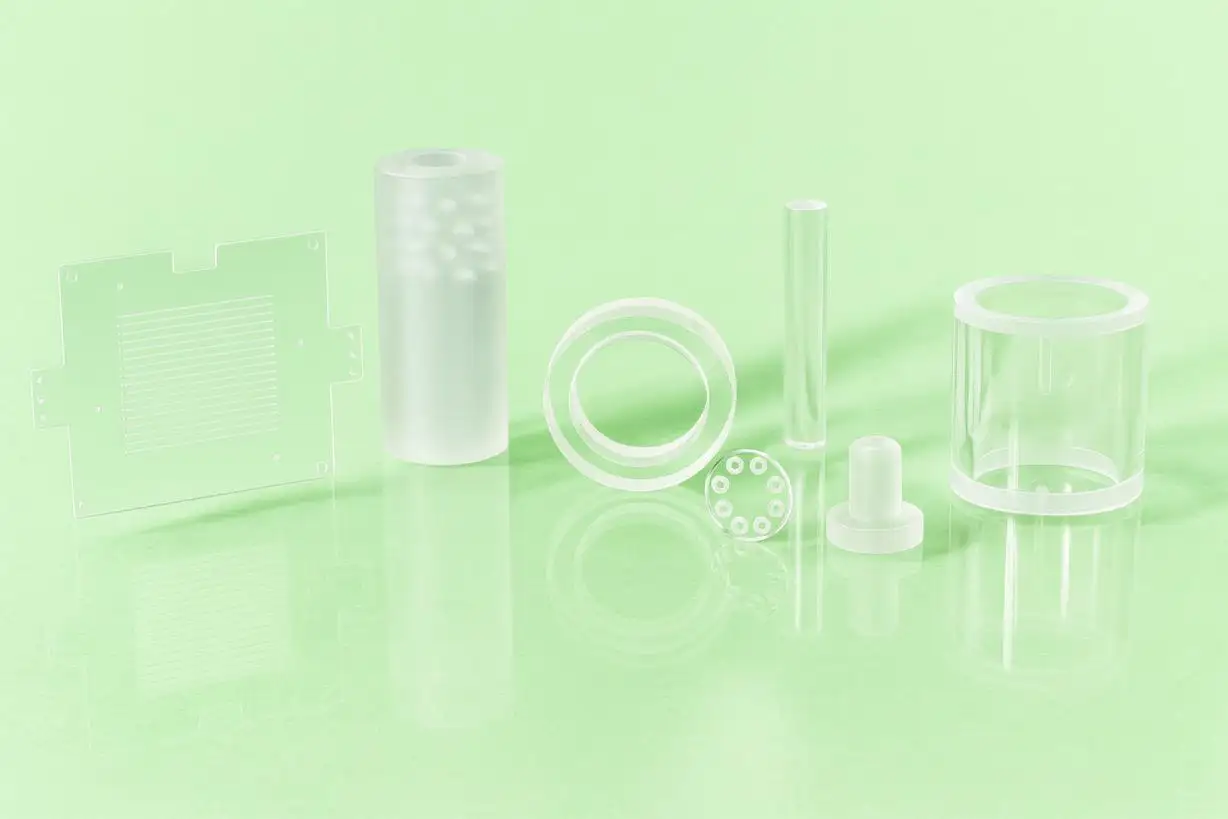
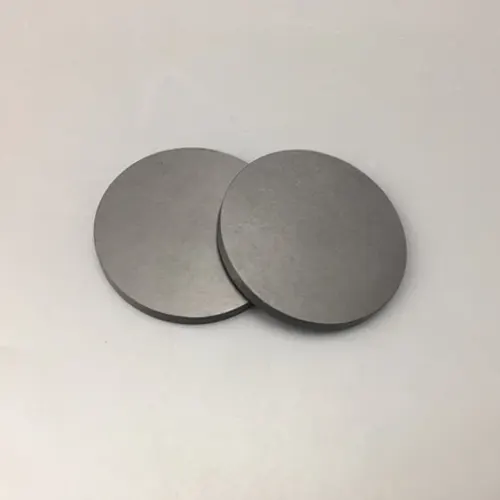
Wafer handling in semiconductor manufacturing requires cleanliness and precision positioning to the nanometer. Traditional shafts wear and generate particles. Zirconia Ceramic Shaft technology, like UPCERA's, does not suffer these issues. In wafer handling, Zirconia Shaft technology replaces metallic interfaces and enhances service life, positional accuracy, and operational cleanliness.
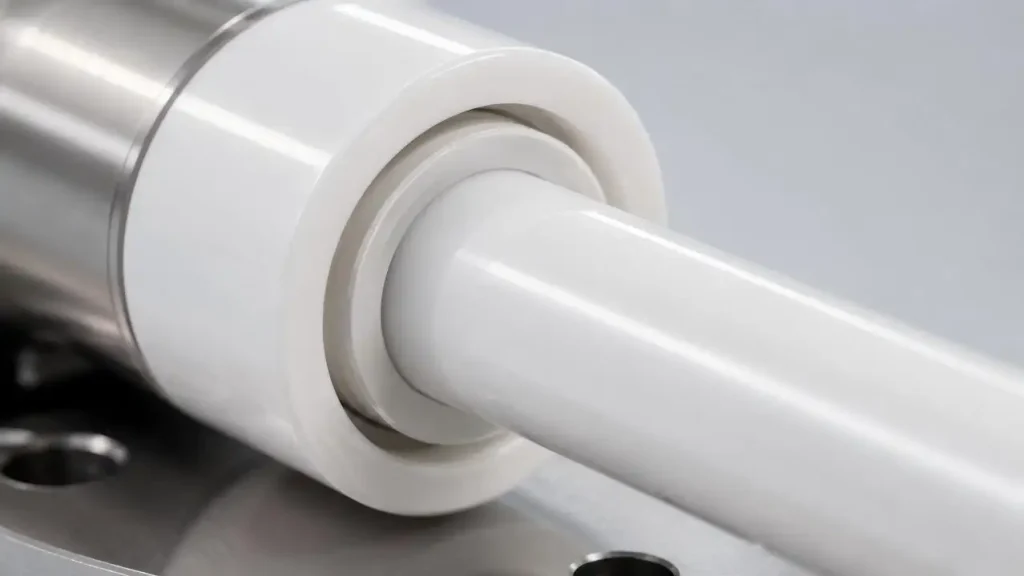
What Is a Zirconia Ceramic Shaft and Bushing Assembly?
A shaft and bushing pair provides a non-metallic interface for frictionless motion. The ceramic shaft maintains a stable axis and the bushing, with a precise inner surface, drifts to the ceramic surface. Unlike metals, ceramics do not drift, and thus maintain surface integrity to the micron level.
Why Zirconia? Material Advantages for Semiconductors
Zirconia has no metal failure modes and has the following properties:
•Hardness & wear resistance: Vickers 1800-2000 HV grants wear resistance for alignment over millions of cycles.
•Fracture toughness: 2-3x toughness of alumina allow for the impact and stress of high speed robots.
•Chemical & corrosion resistance: Serves as an inert, non-particle contaminating material of a gas or liquids.
•Electrical insulation & non-magnetic: Does not interfere with positioning sensors.
•High-temperature stability: Can withstand thermal cycles without alteration of structure.
Precision That Matters: UPCERA's Machining Capabilities
Material properties are necessary, but not sufficient for semiconductor applications. Zirconia Ceramic Shaft must be of a precise tolerance to fit in a low friction combination. UPCERA precisely, and according to customer specs, transforms raw Zirconia to a ceramic shaft for wafer handling equipment.
The following are the important specifications of UPCERA's Ceramic Shaft and Bushing Assembly:
•Length Range: ≤300 mm, offering design flexibility for many wafer handling systems
•Outer Diameter: ≤150 mm, compatible with compact and large-format motion stages
•Surface Roughness: Ra 0.02–0.2, ultra-smooth surfaces of minimal friction and heat generation, either during contact and rotary or sliding motions
•Minimum Wall Thickness: 0.1 mm, space-saving and lightweight design
•Roundness: 0.002 mm, no runout and hence true circular motion
•Concentricity: 0.002 mm, no runout between axes of the shaft and bushing
•Straightness: 0.004 mm, no binding, and no uneven loading along the shaft
•Perpendicularity: 0.005 mm, no angular error along any of the multiple positional axes a component may assume
These tolerances enable parts that fit on first assembly and keep interfaces true over extended service. Under some circumstances, UPCERA can achieve surface finishes to Ra 0.02, greatly reducing, or even eliminating, the need for secondary polishing.
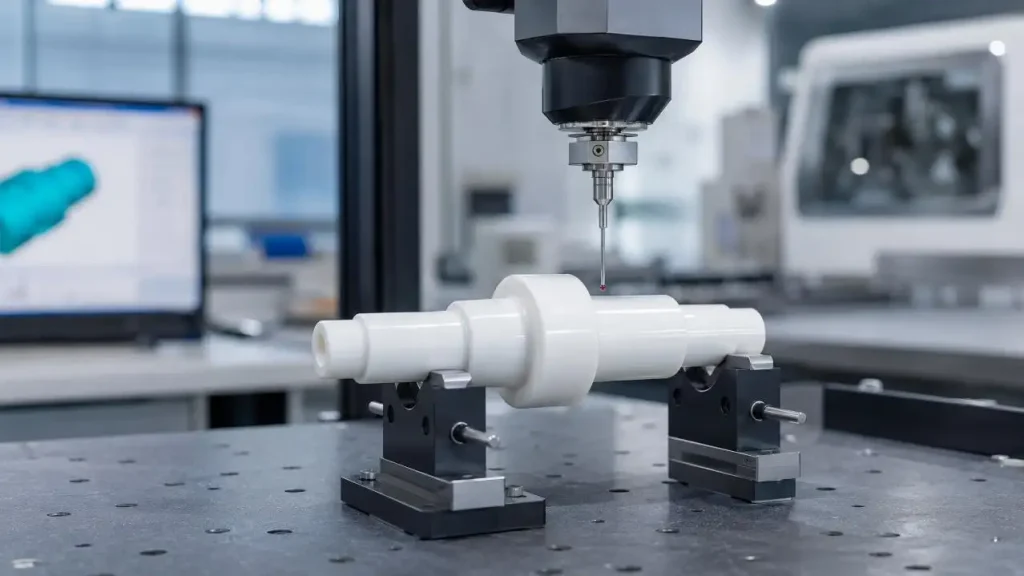
Wafer Handling and the Role of Ceramic Shaft and Bushing Assembly
Wafer handling is the automated transport of silicon wafers to different processing stations using a series of robotic arms, end effectors, and motion stages. The Zirconia Ceramic Shaft is a vital component to a number of systems in wafer handling.
Wafer Transfer Robots
•Function: Robotic arms used for transporting wafers between processing, loading, and inspection stations.
•Ceramic Contribution: Wear resistant, low friction Zirconia Ceramic Shaft are used for the joints and guideways.
•Benefit: Provides high reliability and the precision of placing wafers with low maintenance.
Wafer Positioning Stages
•Function: Motion stages used for placing wafers for operation s such as lithography, inspection, and others.
•Ceramic Contribution: Ceramic Shaft and Bushing Assembly with a low friction interface.
•Benefit: Enables high repeatability of positioning leading to high yield of the process.
Load Ports and Transfer Chambers
•Function: Interfaces for transporting wafers from vacuum and controlled atmospheric systems.
•Ceramic Contribution: Door and elevator mechanisms of the load ports use Zirconia Ceramic Shaft bushings which seal the vacuum ports and are resistant to the process gas.
•Benefit: Reduced contamination and increased service life.
End Effectors and Forks
•Function: Forks used for engaging wafers in the transfer operation.
•Ceramic Contribution: Motion interfaces of the forks which are made of Alumina are often made of Zirconia Ceramic Shaft bushings.
•Benefit: Minimal mechanical stress on wafers and a clean, contamination-free operation.
Precision Positioning: Where Nanometers Matter
In semiconductor manufacturing, if the positioning of a component is off, the performance is greatly impacted, as is the yield of the device.
There are multiple means of achieving precision positioning within the Ceramic Shaft and Bushing Assembly:
•Geometric Stability: Because Zirconia retains its shape under load and temperature variations, Zirconia Ceramic Shaft does not suffer from the "tolerance creep" of metal components. This ensures that positioning systems are maintained over very long production runs.
•Low Friction Operation: UPCERA's Ceramic Shaft and Bushing Assembly have ultra-smooth finishes (Ra 0.02–0.2) resulting in a very low friction coefficient. This means that, when in use, considerably less energy is converted to heat with even finer controllability. Thus, thermal drift is also reduced.
•Precision Fit and Alignment: Tight tolerances provide a backlash-less fit between the bushing and the shaft. This leads to a very advantageous property of the assembly: a high level of defined motion and precision in response to size and position changes.
•Non-Magnetic Operation: Because Zirconia is non-magnetic, interference with electromagnetic positioning sensors and encoders is not an issue. This means that the feedback systems will receive clean and accurate signals.
Applications Beyond Semiconductor Equipment
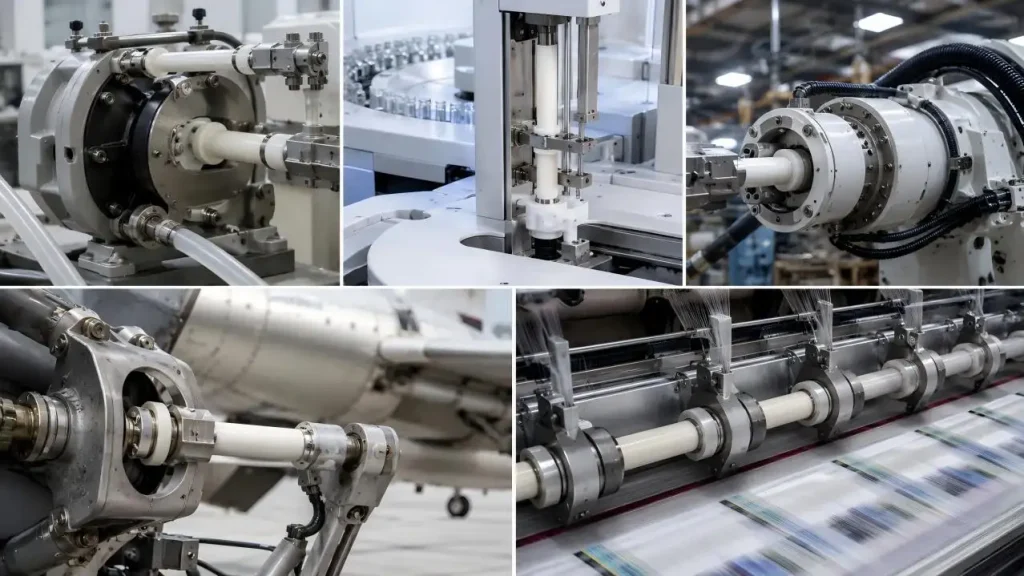
Wafer handling and precision positioning are primary uses for our patented technology. However, the Zirconia Ceramic Shaft and Ceramic Shaft and Bushing Assembly technology can be used in any industry where wear resistance and chemical stability can be paired with friction alignment. These include:
•Pumps and Fluid Handling Systems: this includes chemical pumps and metering in non-reactive and smooth chemical operation as well as medical devices and fluid transport
•Medical Devices and Lab Equipment: Blood pumps and analyzers and other medical equipment operate in sterile and corrosion resistant environments
•Industrial Automation: Long-lasting, low friction movement is critical to actuators, robotics, and conveyors
•Aerospace and Defense: high-performance systems with thermal resistant and high-stress durability
•Textile and Printing Machinery: Long term reliance with high-speed operation and minimal wear
Conclusion: The Future of Precision Motion
As semiconductor devices become smaller and have greater numbers of components, motion systems will be required to advance with them. Zirconia Ceramic Shaft technology is a step forward in the right direction with Ceramic Shaft and Bushing Assemblies from UPCERA. The rapid advancement of machining and Zirconia's excellent properties provides wafer handling systems that will be cleaner, more precise, and more reliable. This technology will provide consistent and more profitable systems for manufacturers with less required upkeep and improved output. Zirconia Ceramic Shaft technology isn't a replacement for metal, but a tool to extend the capabilities of semiconductor manufacturing readily.
FAQs
Q1: What is a Zirconia Ceramic Shaft?
It is a high precision ceramic rod providing a durable and stable, friction resistant axis subjected to linear or rotary motions in harsh conditions.
Q2: What are the benefits of using zirconia instead of stainless steel in wafer handling?
Zirconia is very hard and highly resistant to corrosion. It is non‑magnetic and does not wear or produce particles.
Q3: What tolerances does UPCERA offer?
Concentricity and roundness to 0.002 mm, straightness to 0.004 mm and surface roughness of Ra 0.02 and better.
Q4: Is the Ceramic Shaft and Bushing Assembly compatible with vacuum systems?
Yes, Zirconia is non-porous and maintains its integrity in high vacuum conditions and doesn't outgas.
Q5: How does this assembly enhance accuracy of positioning?
Geometric stability, low friction and zero or very minimal backlash are guaranteed for substantial linear and repeatable motion in the nanometers.


